Most enterprises know that their annual budgeting process is out of sync with how work really happens in agile product development. Teams release value every sprint, trains plan every PI, but funding still gets locked once a year in a long, political cycle. The result is slow response to change, zombie projects that keep getting funded, and frustrated product leaders who can see opportunities but can’t move money fast enough.
SAFe (Scaled Agile Framework) solves this with a shift from project-based annual budgeting to continuous funding of value streams. Instead of asking “Which projects do we fund this year?”, portfolio leaders move to “Which value streams do we invest in, and how do we adjust that investment as we learn?” This sounds simple, but it represents a deep cultural and financial transformation.
In this guide, we’ll walk through why annual budgeting breaks down in a SAFe environment, what continuous funding looks like in real life, and how portfolio leaders, Product Managers, Scrum Masters, and Release Train Engineers can make this shift without losing financial control.
Why Annual Budgeting Fights Against Business Agility
Annual budgeting came from a world of big, upfront projects, stable plans, and multi-year roadmaps that barely changed. SAFe assumes the opposite: uncertain environments, changing strategies, and learning through short feedback loops. When you try to run SAFe on top of a rigid annual funding model, the friction shows up everywhere.
1. Strategy Changes Faster Than the Budget
Executives revisit strategy several times a year. Markets move, competitors launch new products, regulations change, and technology opens fresh opportunities. But if funding only changes once a year, the portfolio cannot follow strategy. You end up with teams executing last year’s priorities while leaders talk about this year’s goals in steering committees and town halls.
A strong SAFe portfolio expects change. Leaders who attend SAFe certification learn how to connect strategy and execution continuously, not just at budget season.
2. Projects Create Start–Stop Chaos
Project-based funding means every big initiative spins up a temporary structure: new governance, new reporting, new approvals. Teams get formed, disbanded, re-formed, and moved around. It looks organized on paper, but in reality it destroys flow:
- Teams lose context every time they are re-assigned.
- Knowledge walks away when a project “ends”.
- People optimize for “finishing the project” instead of “maximizing long-term value”.
SAFe encourages stable Agile Release Trains (ARTs) and long-lived teams that stay focused on a value stream. Continuous funding supports that stability, so teams are not constantly chasing the next funded project.
3. Annual Budgeting Encourages Big Upfront Commitments
If the only way to get money is to submit a thick business case once a year, leaders naturally:
- Over-promise benefits to win funding.
- Over-specify scope to “secure” the budget.
- Lock in detailed plans that no one believes will survive contact with reality.
Once approved, that business case becomes a contract. Even when evidence shows the idea is weak, sunk-cost thinking and political risk make it very hard to stop. Continuous funding breaks this pattern by funding options and experiments early, then increasing or decreasing funding as the portfolio learns.
What Continuous Funding Means in SAFe
Continuous funding is not “free-for-all spending”. It is a disciplined way to allocate, adjust, and govern money across value streams based on actual performance and evolving strategy.
1. Fund Value Streams, Not Projects
The biggest structural change is this: instead of funding dozens of separate projects, the portfolio funds a smaller number of value streams. A value stream is a flow of work that delivers value to a specific customer segment or business outcome.
Each value stream has:
- A clear purpose and target outcomes.
- Stable teams organized into one or more ARTs.
- A dedicated budget for a period (often a year), with room for reallocation during the year.
Within that value stream, Product Management and business owners decide which epics, features, and experiments to pursue, based on data and feedback. This is exactly the kind of decision-making covered in depth in SAFe Product Owner/Product Manager (POPM) certification training.
2. Use Guardrails Instead of Micro-Approvals
Continuous funding relies on Lean budget guardrails instead of thousands of individual approvals. Guardrails make sure spending remains aligned with strategy and financial constraints, while still giving ARTs and value streams autonomy.
Typical guardrails include:
- Portfolio-level investment horizons (core, growth, innovation).
- Limits on how much can be invested into any single epic without additional review.
- Expectations for using data and learning milestones before scaling an idea.
These guardrails help portfolio leaders keep control without slowing everything down. Release Train Engineers and Scrum Masters who understand this model can support healthier decision-making during PI Planning and Inspect & Adapt events. A course like SAFe Scrum Master certification provides the foundation for that kind of facilitation.
3. Make Funding Decisions on a Regular Cadence
Continuous funding means the portfolio doesn’t wait a full year to make changes. Many SAFe enterprises introduce:
- Quarterly portfolio reviews to inspect outcomes, adjust budgets, and align with strategy.
- PI-level decisions, where some funding shifts between value streams based on learning and performance.
- Epic-level checkpoints, where funding for a large initiative increases only when empirical evidence supports it.
These decisions happen on a cadence that matches the rhythm of PI Planning and ART events. This is where RTEs and advanced Scrum Masters, especially those trained via SAFe Advanced Scrum Master training, play a crucial role in connecting execution feedback to portfolio discussions.
Key Practices to Move From Annual Budgeting to Continuous Funding
The shift doesn’t happen automatically just because the organization “implements SAFe”. It requires deliberate changes in finance, governance, and leadership behavior. Let’s look at practical steps portfolios can take.
1. Create a Clear Portfolio Vision and Value Stream Map
You cannot fund what you cannot see. The first step is to clarify:
- What are our core value streams?
- Which customers do they serve?
- What outcomes do we expect from each?
This value stream view replaces the project list as the main portfolio lens. It becomes the foundation for both strategy and funding decisions. Leaders with a strong understanding of SAFe principles, often gained in SAFe Release Train Engineer certification training, can guide this mapping effectively and align trains around value instead of components.
2. Shift Financial Language From “Cost” to “Investment”
Annual budgets often frame everything as cost centers and line items. Continuous funding reframes these as investments with expected outcomes and measurable learning. Finance and portfolio leaders work together to define:
- Target outcomes and leading indicators for each value stream.
- How to track benefits (revenue, margin, customer satisfaction, risk reduction, efficiency, etc.).
- What kind of evidence is needed before scaling an idea or doubling down on an epic.
This is closer to a venture capital mindset: invest in a portfolio of options, learn quickly, and reallocate capital based on results.
3. Introduce Participatory Budgeting
Many SAFe enterprises use participatory budgeting, where a broad group of business and technology stakeholders collaborate to propose and allocate investments across value streams. Instead of opaque top-down decisions, the process becomes more transparent and data-driven.
A participatory budgeting event typically:
- Presents strategic themes and constraints.
- Shows current and proposed investments across value streams.
- Lets participants simulate different allocations and see trade-offs.
This builds shared ownership and reduces resistance later, because people have already seen and influenced the trade-offs. Scrum Masters and POPMs who understand facilitation, conflict navigation, and prioritization techniques add huge value here.
4. Use Epics and Lean Business Cases as Learning Tools
In SAFe, epics and Lean business cases are not just approval artifacts. They are tools for reasoning about risk and learning. A Lean business case focuses on:
- The problem and opportunity.
- The hypothesis and expected outcomes.
- Leading indicators and early experiments.
- Rough sizing of the investment, not a detailed Gantt chart.
Funding decisions then happen in stages: small initial funding for exploration, more funding once evidence supports the hypothesis, and sometimes deliberate stopping when learning shows the idea is not viable. This incremental approach reduces waste and keeps the portfolio aligned with reality instead of wishful thinking.
5. Connect PI Planning Outcomes Back to Funding
Continuous funding becomes real when PI Planning and portfolio decisions talk to each other. Here’s how that can look:
- Strategic themes and funding changes feed into the preparation for PI Planning.
- ARTs reflect those changes in the features and objectives they commit to.
- After the PI, actual outcomes and flow metrics inform the next funding adjustments.
This loop turns funding into a living system rather than a once-a-year ceremony. It’s also where skilled Scrum Masters and RTEs, grounded in frameworks like the SAFe Scrum Master certification, can make a clear difference by improving transparency and flow.
What Finance Needs to Feel Safe With Continuous Funding
Finance leaders usually worry about three things: control, predictability, and compliance. If continuous funding feels like “losing control”, they will resist it, even if the rest of the organization loves SAFe. The goal is not to push finance aside, but to give them a better model for risk management.
1. Clear Guardrails and Approval Thresholds
Finance needs to know:
- Who can approve what level of spending?
- When does an epic need a more formal financial review?
- What are the limits for reallocation between value streams without executive approval?
Answering these questions explicitly reduces fear and creates a shared understanding of how decisions are made. It also helps ARTs move faster because they know where they have real authority to act.
2. Better Forecasting With Smaller, More Frequent Adjustments
One misconception is that continuous funding makes forecasting impossible. In practice, the opposite usually happens. When value streams report regularly on flow, outcomes, and capacity, finance gets a more honest and current view, instead of an annual guess that goes stale after a few months.
You still set an annual funding envelope for each value stream, but you reserve a portion of the budget for reallocation and innovation. Over time, patterns emerge and forecasting becomes more accurate, not less.
3. Transparency Over Individual Projects
Finance and audit often need traceability for how money is used. Continuous funding doesn’t remove that; it changes the unit of analysis. Instead of chasing every project, you:
- Track funding decisions at the value stream and epic level.
- Maintain lightweight visibility into how much investment goes to each epic over time.
- Connect that investment to outcomes and learning, not just deliverables.
This level of transparency supports compliance requirements while still keeping overhead manageable.
Typical Pitfalls When Moving to Continuous Funding
The concept is attractive, but execution can go wrong. Here are common pitfalls and how to avoid them.
1. Renaming Projects as Value Streams Without Changing Behavior
Some organizations simply relabel projects as “value streams” and keep all the old behaviors: detailed upfront business cases, annual approvals, and fixed-scope plans. Nothing really changes. To avoid this, focus on:
- Stable, long-lived teams aligned to customer-centric value streams.
- Local decision-making on which work to pursue within the value stream budget.
- Guardrails and metrics instead of hand-crafted approvals for each initiative.
2. Moving Too Fast Without Finance as a Partner
If agile leaders try to bypass finance or treat them as an obstacle, the change will stall. Bring finance into the design of the new funding model early. Work together on guardrails, reporting formats, and compliance expectations. Training key finance partners in SAFe principles, using programs like SAFe agile certification, can bridge language gaps and build trust.
3. No Clear Metrics for Learning and Outcomes
Continuous funding depends on real feedback. If value streams cannot show:
- What they shipped.
- What changed for customers or the business.
- What they learned and what they will do differently.
then funding debates become opinion battles again. Invest early in defining a small, meaningful set of portfolio and value stream metrics. Flow metrics, customer outcomes, and leading indicators of business impact are a good starting point.
The Role of Key SAFe Roles in Continuous Funding
Moving from annual budgeting to continuous funding is not just a finance project. It requires alignment across leadership, Product Management, Scrum Masters, and RTEs.
Portfolio and Enterprise Leaders
- Define strategic themes and investment horizons.
- Own the value stream map and funding envelopes.
- Champion participatory budgeting and guardrails.
Product Owners and Product Managers
- Translate strategy into epics, features, and options.
- Use data to argue for or against increasing funding for specific ideas.
- Continuously reorder the backlog to reflect the latest learning.
Skills for this work are exactly what professionals deepen in SAFe POPM certification training, where the focus is on maximizing value flow rather than just pushing scope.
Scrum Masters and Advanced Scrum Masters
- Improve team-level flow so value streams can make realistic commitments.
- Facilitate Inspect & Adapt events where funding decisions get grounded in evidence.
- Help teams visualize work, dependencies, and bottlenecks to support better portfolio choices.
Practitioners who extend their skills with programs like SAFe Advanced Scrum Master certification training are especially well-positioned to support this evolution.
Release Train Engineers
- Connect ART-level execution data (throughput, predictability, dependencies) to portfolio views.
- Facilitate PI Planning so funding changes are reflected in ART commitments.
- Shape the Inspect & Adapt workshop so it highlights information useful for funding decisions.
This is why many organizations invest in SAFe Release Train Engineer certification training for those leading one or more ARTs.
How to Start: A Practical Roadmap for Moving to Continuous Funding
You do not need to redesign your entire financial system in one step. A staged approach is more realistic and less risky.
Step 1: Choose One Portfolio or Value Stream as a Pilot
Pick a portfolio slice where:
- Leadership is supportive.
- Teams already operate in SAFe ARTs.
- The current project-based funding model is clearly causing pain.
Agree up front on what will change and what will stay the same for the pilot year.
Step 2: Define Guardrails and Funding Envelopes
Work with finance to:
- Set a rough annual budget envelope for the pilot value stream(s).
- Decide what percentage is flexible for reallocation.
- Define approval thresholds and decision rights.
Document these guardrails clearly so everyone knows how decisions are made.
Step 3: Run a Simple Participatory Budgeting Session
Invite business owners, Product Managers, RTEs, and financial partners. Present:
- Strategic themes and constraints.
- Candidate epics and investment ideas.
- Simulated funding options and trade-offs.
Agree on an initial allocation across value streams and epics, then set dates for review and adjustment.
Step 4: Integrate Funding Conversations With PI Events
Make sure that:
- Before PI Planning, leaders share any funding shifts or strategic changes.
- During PI Planning, teams discuss how those shifts affect objectives.
- After each PI, outcomes flow back to portfolio and finance in a simple, consistent format.
This creates the heartbeat for continuous funding decisions.
Step 5: Inspect, Adapt, and Scale
After a few PIs, review:
- What became easier with continuous funding?
- Where did governance or compliance feel weak?
- What information did finance still miss?
Adjust guardrails, metrics, and roles. Once the pilot shows tangible benefits, start expanding the model to other portfolios.
Final Thoughts
Moving from annual budgeting to continuous funding in SAFe is not a minor process tweak. It is a shift in how the organization thinks about money, risk, and learning. Instead of betting big once a year, the portfolio spreads its bets, learns faster, and moves capital where it can do the most good.
When portfolio leaders understand SAFe deeply, product people know how to use epics and data, and Scrum Masters and RTEs drive transparency and flow, continuous funding becomes a natural next step. It aligns strategy, teams, and money around one goal: delivering real value to customers, again and again.
Also read - How to Build a Lean Portfolio Budgeting Model That Actually Works
Also see - A Practical Guide to Participatory Budgeting Workshops
Participation improves information, not just buy-in
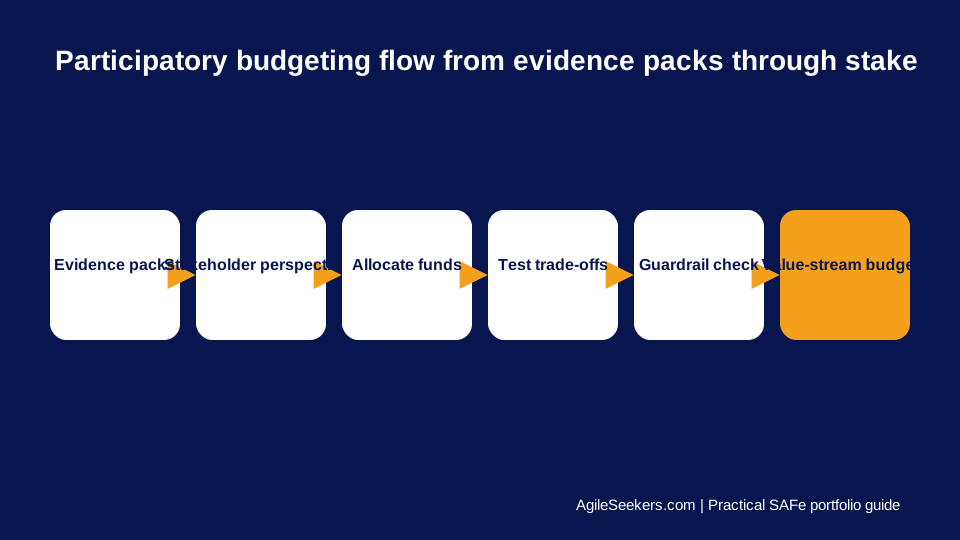
Participatory Budgeting is a collaborative process for allocating a portfolio budget to value streams. It brings business, technology, financial, operational, and customer perspectives into difficult choices. The workshop is credible only when participants can move allocations and understand what increased funding displaces.
Prepare comparable value-stream evidence
- Strategic outcomes and current leading indicators.
- Existing budget, capacity, commitments and operational load.
- Solution health, lifecycle, technical risk and regulatory demand.
- Epic options, MVP learning and forecast ranges.
- Requested change with consequences at lower, expected and higher allocation.
Facilitate allocation in rounds
Begin with enterprise and portfolio constraints, then let participants allocate independently before group negotiation. Surface the reasoning behind major differences. Test the emerging allocation against investment horizons, capacity allocation, significant initiatives, and continuing Business Owner engagement. Avoid letting seniority decide before distributed knowledge becomes visible.
After the workshop
- Publish allocations, ranges, assumptions and dissent.
- Translate funding into value-stream capacity boundaries without prescribing every feature.
- Update portfolio roadmap and Kanban implications.
- Set leading outcome and solution-health reviews.
- Name conditions that trigger reallocation before the next workshop.
Leading SAFe certification training provides the Lean Portfolio Management context. SAFe RTE training helps value-stream representatives bring credible flow and capacity evidence into the allocation conversation.