Security failures rarely come from a single bad decision. They come from gaps. Gaps between teams, gaps between stages of delivery, and gaps between intent and execution. In large-scale Agile environments, those gaps widen fast if security stays bolted on at the end.
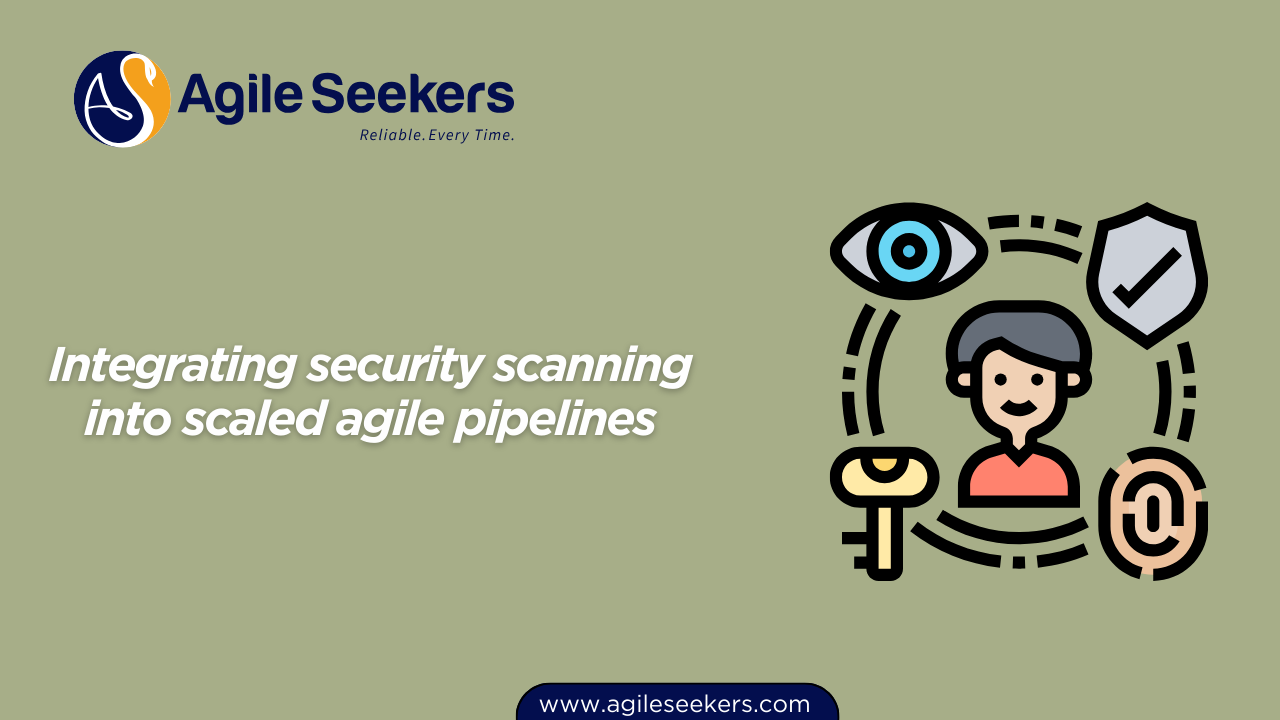
Integrating security scanning into scaled Agile pipelines is not about slowing teams down or adding more gates. It’s about making security part of flow, just like quality, performance, and reliability. When done well, security scanning becomes invisible but effective, embedded into how Agile Release Trains deliver value.
Why security breaks down at scale
Small teams can sometimes rely on informal checks or manual reviews. That model collapses once multiple teams, shared components, and frequent releases enter the picture. In a scaled setup, one vulnerable library or misconfigured service can propagate risk across dozens of products.
Common failure patterns show up again and again:
- Security checks happen late, often during hardening or release approval.
- Findings lack context, so teams argue instead of fixing.
- Different teams use different tools, producing inconsistent signals.
- Leadership sees security as a compliance task rather than an engineering discipline.
What this really means is that security does not flow with delivery. And anything that does not flow will eventually block.
Scaled Agile changes the security conversation
Frameworks like SAFe force organizations to think in systems. Value streams, Agile Release Trains, and Program Increments all expose how work moves from idea to deployment. Security scanning must follow that same path.
Instead of asking “Did we scan this?” the better question becomes “Where does scanning create the most learning with the least disruption?”
Lean-Agile leaders trained through SAFe agile certification programs often recognize this shift early. Security becomes a shared responsibility tied to flow, not a separate approval step.
Shift security scanning left, but not blindly
“Shift left” gets thrown around a lot, and often misunderstood. It does not mean running every possible scan on every commit. That approach overwhelms teams and erodes trust in the pipeline.
Effective shift-left security follows a few clear principles:
- Fast feedback first, deep analysis later.
- Automate what teams can act on immediately.
- Delay expensive scans until architectural boundaries stabilize.
Static Application Security Testing (SAST) works well early because it analyzes code as it is written. Software Composition Analysis (SCA) belongs even earlier, since dependency risks emerge the moment a library enters the codebase. Dynamic testing and penetration-style scans fit better closer to system integration.
Organizations aligned with OWASP guidance on secure development often structure scans this way. Resources like the OWASP Top 10 provide a practical baseline for deciding what risks deserve early attention.
Designing security scanning for Agile Release Trains
Agile Release Trains introduce a unique challenge. Multiple teams contribute to a shared solution, often on different cadences. Security scanning must respect that reality.
A useful pattern is to treat security scanning as a system-level capability rather than a team-level tool choice. The ART establishes:
- Standard scanning tools approved for use across teams.
- Clear thresholds for build warnings versus build failures.
- Shared dashboards visible during PI execution.
This is where Release Train Engineers play a critical role. RTEs trained through SAFe Release Train Engineer certification programs often act as integrators, ensuring security signals surface during ART syncs instead of surprising teams at the end.
Embedding security into CI/CD without killing flow
Continuous Integration and Continuous Deployment pipelines are the backbone of scaled Agile delivery. Security scanning must integrate directly into these pipelines, not live in parallel systems.
A practical layered approach works best:
- Commit stage: Lightweight SAST and secret scanning.
- Build stage: Dependency and license checks.
- Integration stage: Container and infrastructure scanning.
- Pre-release stage: DAST and system-level security tests.
The goal is not perfection at every step. The goal is progressive risk reduction. Teams should see security findings while they still remember writing the code.
Security standards from organizations like NIST’s Cybersecurity Framework often map cleanly onto this layered model, especially for enterprises operating in regulated environments.
Making security findings practical for teams
One of the fastest ways to lose team buy-in is to dump raw vulnerability reports into a backlog. Scaled Agile environments demand prioritization and context.
Product Owners and Product Managers trained through SAFe POPM certification programs often lead the shift here. They translate security findings into business-relevant backlog items.
Effective practices include:
- Tagging findings to affected features or capabilities.
- Using risk severity aligned with business impact.
- Scheduling remediation within normal PI planning, not as emergency work.
When security work competes transparently with other priorities, teams stop seeing it as “extra work” and start seeing it as part of value delivery.
The Scrum Master’s role in secure delivery
Scrum Masters influence flow more than most roles realize. In scaled settings, they help teams navigate constraints without cutting corners.
Scrum Masters who complete SAFe Scrum Master certification training often focus on removing systemic impediments. Security scanning frequently exposes those impediments, such as unstable environments, unclear ownership, or unrealistic WIP limits.
Advanced practitioners, especially those with SAFe Advanced Scrum Master certification, help teams experiment with better automation, clearer Definition of Done criteria, and improved feedback loops around security issues.
Security as part of Definition of Done
If security scanning sits outside the Definition of Done, it will always feel optional. Scaled Agile organizations that mature in this space explicitly include security expectations at multiple levels.
Examples include:
- Stories pass baseline SAST checks before completion.
- Features meet agreed vulnerability thresholds.
- PI Objectives account for known security remediation work.
This does not mean blocking delivery for every low-risk finding. It means making risk visible and intentional.
System Demos and Inspect & Adapt events
Security scanning data becomes powerful when teams review it together. System Demos offer a chance to show not just features, but the health of the solution.
Inspect & Adapt workshops can highlight trends:
- Repeated vulnerability patterns across teams.
- Pipeline stages causing the most rework.
- Dependencies that introduce recurring risk.
These insights drive structural improvement rather than one-off fixes.
Measuring what matters in security scanning
Counting vulnerabilities alone tells very little. Scaled Agile leaders look for metrics that support learning and decision-making.
- Time to remediate high-risk findings.
- Percentage of findings caught before integration.
- Recurring vulnerability types per PI.
When teams see progress over time, security stops feeling abstract.
Common mistakes to avoid
Even well-intentioned efforts can backfire. Watch out for these traps:
- Running too many scans too early.
- Blocking builds without clear guidance.
- Treating tools as a substitute for engineering judgment.
- Isolating security specialists from ART events.
Security improves when it stays close to the work.
Where this leaves scaled Agile organizations
Integrating security scanning into scaled Agile pipelines is not a tooling problem. It is a systems design problem. When scanning aligns with flow, roles, and decision-making, security becomes part of how value gets delivered.
Organizations that succeed here treat security as a capability that evolves PI by PI. They invest in leadership alignment, clear ART-level standards, and practical automation that teams trust.
That is how security stops being the last-minute blocker and starts becoming a quiet enabler of sustainable delivery.
Also read - Shift-left test automation strategies for ARTs
Also see - How to build a resilient CD pipeline for multiple ARTs