When multiple Agile teams work on the same product or value stream, coordination becomes the difference between flow and friction. One team delivers on time. Another waits on a dependency. A third builds something that no longer aligns with business priorities. Soon, progress slows, tension rises, and leadership starts asking uncomfortable questions.
Coordination failure between teams rarely announces itself clearly. It shows up as missed PI Objectives, unpredictable releases, growing rework, and endless dependency discussions. If you want to fix it, you first need to diagnose it properly.
This guide walks you through how to identify coordination breakdowns across Agile teams and Agile Release Trains, what signals to watch for, and how to address the root causes instead of treating symptoms.
What Coordination Failure Actually Looks Like
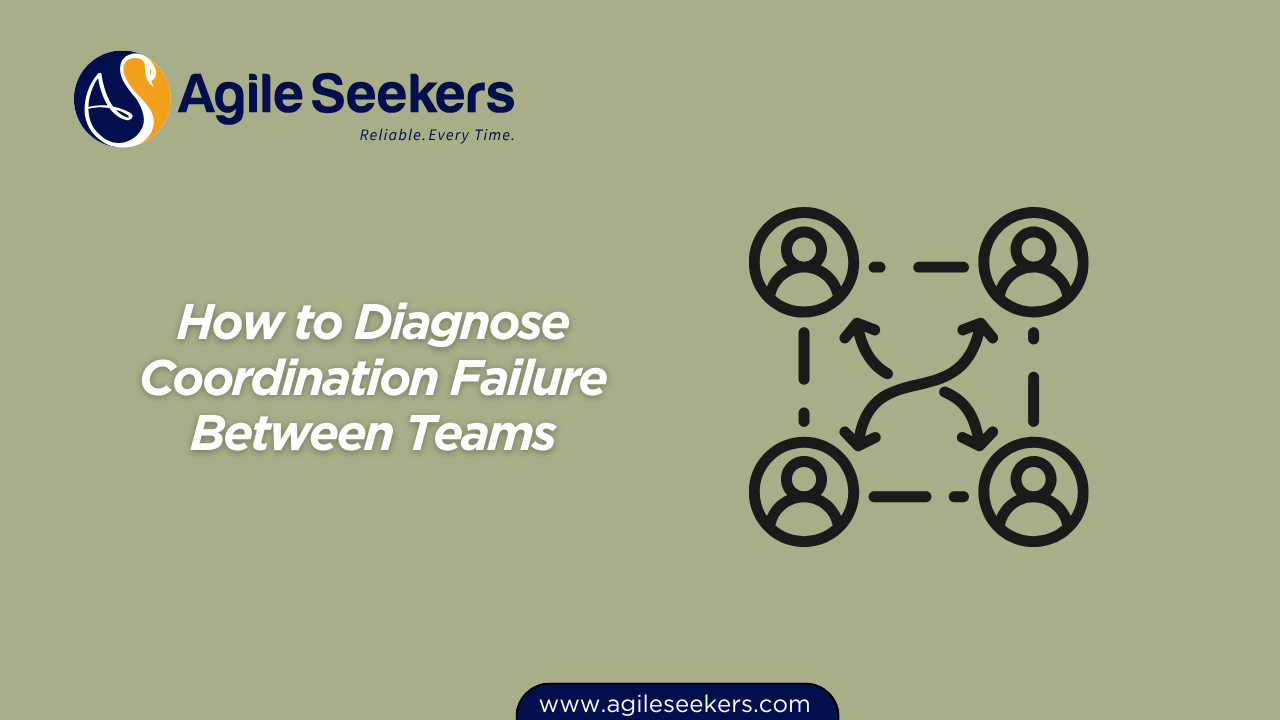
Let’s define the problem clearly. Coordination failure between teams occurs when teams working toward shared outcomes fail to align on priorities, dependencies, timing, or technical integration.
The focus is system-level misalignment rather than individuals underperforming.
In a SAFe setup, coordination issues often surface during:
- PI Planning events
- System Demos
- ART Sync meetings
- Inspect & Adapt workshops
According to the Scaled Agile Framework (SAFe), alignment and transparency drive execution. When coordination breaks down, both suffer.
Early Warning Signs of Coordination Failure
1. Repeated Dependency Surprises
Teams discover critical dependencies late in the sprint or mid-PI. Work stalls. People scramble. This is not bad luck. It signals poor cross-team visibility.
2. Inconsistent PI Objective Achievement
If some teams consistently miss PI Objectives due to external blockers, coordination may be the root cause. The problem isn’t capacity. It’s sequencing and synchronization.
3. Duplicate or Conflicting Work
Two teams unknowingly build similar features. Or worse, they implement conflicting logic. That indicates weak product-level alignment.
4. Escalation Becomes the Default
If every cross-team issue needs leadership intervention, collaboration mechanisms are failing.
5. Integration Pain During System Demo
System Demo should validate integrated value. If integration repeatedly fails, coordination gaps exist at design, architecture, or backlog levels.
Step-by-Step: How to Diagnose Coordination Failure Between Teams
Step 1: Map the Dependency Network
Start with visibility. During PI Planning or retro sessions, map out:
- Feature-to-team ownership
- Cross-team dependencies
- External system touchpoints
- Shared components
Visualize this on a board or dependency map. Patterns emerge quickly. If one team sits at the center of most dependencies, you’ve found a bottleneck.
Dependency mapping is a core capability taught in structured programs like SAFe Release Train Engineer Certification Training, where leaders learn to manage ART-level flow.
Step 2: Analyze Flow Metrics Across Teams
Use objective data. Look at:
- Cycle time variation between teams
- Blocked time due to dependencies
- Carry-over work across PIs
- Rework rates after integration
If blocked time spikes whenever Team A depends on Team B, you don’t have a team performance issue. You have a coordination design problem.
Resources from the Project Management Institute (PMI) also emphasize measuring cross-functional performance, not just individual productivity.
Step 3: Evaluate PI Planning Quality
Many coordination failures begin in PI Planning. Ask these questions:
- Did teams discuss sequencing deeply or just estimate effort?
- Were architects involved early?
- Did Product Management clarify feature intent?
- Were risks documented and owned?
If PI Planning becomes a scheduling exercise instead of a collaboration workshop, coordination suffers.
Professionals trained through SAFe agile certification understand how alignment, decentralized decision-making, and shared vision reduce these breakdowns.
Step 4: Examine Backlog Structure and Ownership
Coordination issues often hide in backlog design.
Common backlog red flags:
- Features split across teams without clear acceptance boundaries
- Technical enablers added late
- Weak Definition of Done across teams
- Overlapping feature ownership
Strong Product Owners and Product Managers reduce ambiguity here. Programs like SAFe Product Owner Product Manager Certification focus heavily on feature clarity and alignment.
Step 5: Observe ART Sync Dynamics
ART Sync exists to surface cross-team impediments early. If it becomes a status meeting, coordination risks stay hidden.
Look for:
- Teams hesitating to raise blockers
- RTE solving everything alone
- Unclear follow-up on dependency risks
Healthy ART Sync meetings feel collaborative, not hierarchical.
Step 6: Assess Technical Architecture Alignment
Sometimes coordination failure isn’t behavioral. It’s architectural.
When teams work on tightly coupled systems without modular boundaries, dependencies multiply.
Ask:
- Do teams own clear components?
- Does the architecture support independent delivery?
- Are integration tests automated and shared?
Research from Martin Fowler consistently highlights the impact of architecture on team autonomy and coordination efficiency.
Step 7: Conduct Cross-Team Retrospectives
Team retrospectives often miss systemic coordination issues because teams reflect only on internal dynamics.
Run a cross-team retro at ART level. Focus on:
- Dependency pain points
- Communication breakdowns
- Decision latency
- Escalation patterns
Patterns become clear when multiple teams share their perspective.
Scrum Masters trained through SAFe Scrum Master Certification and advanced practitioners from SAFe Advanced Scrum Master Certification Training often facilitate these sessions effectively.
Root Causes of Coordination Failure
After diagnosing, you’ll usually find one or more of these root causes:
1. Misaligned Priorities
Teams optimize locally instead of for ART-level outcomes.
2. Weak Feature Definition
Ambiguous acceptance criteria create downstream confusion.
3. Poor Dependency Forecasting
Teams underestimate integration complexity.
4. Organizational Silos
Reporting lines discourage cross-team collaboration.
5. Architectural Coupling
Systems force teams to wait on each other.
How to Fix Coordination Failures
Strengthen PI Planning Discipline
Push teams to validate sequencing and risk ownership before committing.
Improve Feature Slicing
Ensure each feature aligns to a single primary team where possible.
Introduce Flow-Based Metrics
Track blocked time and dependency delays visibly.
Run Regular Cross-Team Reviews
Don’t wait for Inspect & Adapt. Address friction mid-PI.
Reduce Technical Coupling
Invest in architectural runway and modular boundaries.
Coordination Is a Leadership Capability
Diagnosing coordination failure between teams requires systemic thinking. Leaders must shift focus from individual team velocity to overall value flow.
When coordination works, teams move with clarity. Dependencies surface early. Integration feels smooth. PI Objectives feel realistic instead of aspirational.
When it fails, even strong teams struggle.
If you want sustainable coordination across Agile teams, invest in role clarity, architectural alignment, and strong facilitation capabilities. SAFe certifications such as Leading SAFe, POPM, Scrum Master, Advanced Scrum Master, and Release Train Engineer programs provide structured guidance on solving these system-level challenges.
Final Thoughts
Coordination failure between teams is rarely about talent. It’s about structure, visibility, and shared ownership.
Diagnose with data. Observe interactions. Map dependencies. Listen across teams.
Then redesign the system so coordination becomes natural, not forced.
That’s how Agile Release Trains deliver consistent value instead of unpredictable outcomes.
Also read - Why Dependencies Multiply in Growing Organizations
Also see - How to Reduce Rework Between System Demo and Release