Some products move so quickly that a traditional roadmap feels outdated the moment you finish it. Teams add new features, market shifts appear out of nowhere, and customer expectations rise without warning. When the product environment moves this fast, you need a roadmap style that can keep up. That’s where a theme-based roadmap steps in. It gives you direction without locking your teams into premature commitments.
Let’s break down how to design a theme-based roadmap that stays relevant even when your product evolves faster than your release cycles. You’ll see where strategy meets adaptability, how teams stay aligned, and why this approach works especially well for digital products with short feedback loops.
What a Theme-Based Roadmap Actually Does
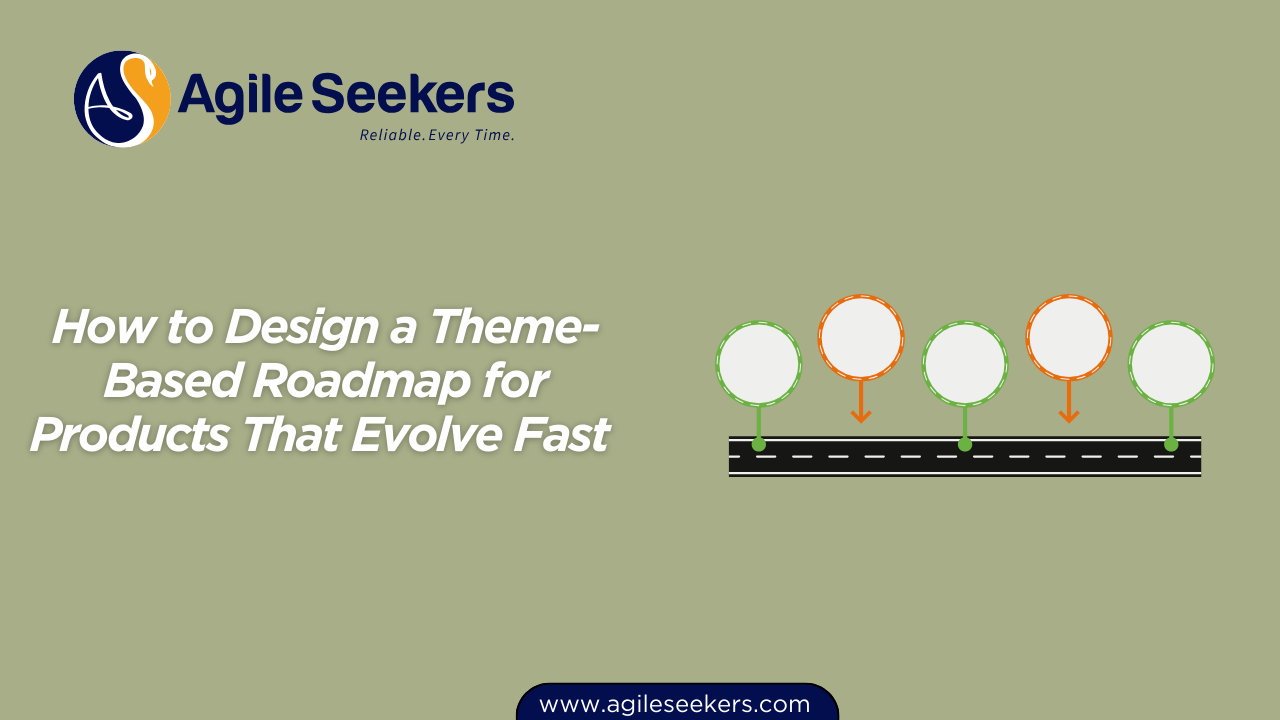
A theme-based roadmap organizes work around strategic themes instead of individual features. A theme could be anything that delivers a measurable outcome. For example, Reduce onboarding friction, Improve performance for mobile users, or Enable data-driven decision-making for admins. Themes sit one level above epics and features, and that’s what makes them perfect for fast-moving products.
A feature roadmap makes you react to every change. A theme-based roadmap helps you adapt to change.
Themes give you the breathing room to explore different ways to solve a problem instead of committing to a specific solution too early. When product direction shifts mid-quarter, you aren’t backing out of promises, you’re simply refining how you deliver the same outcome.
Why This Approach Works So Well for Fast-Evolving Products
When your product changes rapidly, your team can’t afford rigid long-term planning. Themes allow you to anchor your work on customer value, not specific outputs. This gives product managers, engineering teams, and business leaders a shared sense of where the product is heading while still leaving enough space to adjust.
Here’s what this means in practice:
- You avoid rework that comes from planning features too early.
- You keep stakeholders aligned even when the execution keeps shifting.
- You build optionality into your roadmap instead of locking your path.
- You can adapt timelines when new insights arrive from users, market trends, or technical constraints.
If you want to develop the strategic thinking needed for this style of planning, the Leading SAFe certification is a good starting point because it sharpens your ability to turn vision into structured execution.
Step 1: Start with the Product’s Long-Term Narrative
A theme-based roadmap still needs direction. Without a long-term narrative, themes become a random list of improvements. The narrative describes the type of product you’re building and why it matters.
A solid narrative answers questions like:
- Who is the product evolving for?
- What future capabilities unlock strategic advantage?
- How will the product compete or differentiate?
- What outcomes matter the most in the next year?
The narrative becomes the anchor for choosing and prioritizing themes. Make it succinct, aspirational, and grounded in realistic opportunities. A theme-based roadmap should feel like a natural extension of this long-term story.
Step 2: Identify the Strategic Problems You Need to Solve
Instead of starting with features, start with problems. Fast-evolving products evolve because the problems they solve keep changing. Some problems disappear, others expand, and new ones appear from usage insights or market shifts.
You can identify the right problems by combining:
- User research
- Customer interviews
- Heatmap and product analytics tools
- Competitive field evaluations
- Support and operational feedback loops
This is where the Product Owner mindset shines. If your role involves shaping product direction, the SAFe POPM certification helps you deepen those skills, especially when turning insights into high-impact themes.
Step 3: Convert Problems into Themes
Once you’ve identified the right challenges, turn them into themes. A good theme has three qualities:
- Outcome-driven. It states the result you want, not the features you plan to build.
- Broad enough to give solution flexibility. A theme might represent multiple ways to solve the same problem.
- Specific enough to focus effort. Avoid themes like “Improve product experience” because it can mean anything.
Examples of well-framed themes:
- Shorten onboarding time for new customers
- Improve mobile reliability during peak traffic
- Reduce complexity for first-time admins
- Increase cross-team collaboration within the product suite
Instead of committing to individual features, you commit to solving the problem. This creates room for experimentation and ensures that the roadmap doesn’t crumble when direction shifts.
Step 4: Align Themes with Business Impact
Some themes sound good but don’t significantly influence business goals. A theme-based roadmap only works when every theme ties back to measurable value.
Look at your current product goals, growth, retention, activation, engagement, cost reduction, or expansion. Then connect each theme to one or more of those goals.
For example:
- Reduce onboarding time → increases activation
- Improve admin tooling → lowers support cost
- Expand integrations → improves adoption
- Enhance performance → boosts retention
If your product team operates within a scaled environment across multiple Agile Release Trains, understanding how these themes connect to value streams becomes essential. This is where programs like the SAFe Release Train Engineer certification support deep alignment.
Step 5: Break Themes Down into Epics and Feature Options
This is where a theme-based roadmap retains its flexibility. Themes break into epics, and epics break into feature options, not commitments.
Feature options help teams explore alternatives without locking down scope too early. This is crucial for fast-evolving products because you don’t know which path will remain valid a few months from now.
Feature options help you answer questions like:
- What’s the fastest path to verify this concept?
- What gives us the highest value with the least complexity?
- What’s the MVP version?
- What’s the ideal long-term version?
The Scrum teams working on these items play a huge role here. To strengthen your ability to navigate this, the SAFe Scrum Master training can help frame how execution meets strategy.
Step 6: Prioritize with a Simple, Transparent System
Themes can look strategic, but without clear prioritization they lose their impact. Keep your prioritization method simple enough to apply consistently.
Popular, straightforward approaches include:
- Weighted Shortest Job First (WSJF)
- Effort vs. Value scoring
- Opportunity scoring
- Cost of delay
- Impact mapping
WSJF fits well if your organization already works within a scaled Agile setup. Even if you’re not fully scaled, it gives teams a fair, objective way to decide what to attack first.
If you want to go deeper into how prioritization ties into system thinking, the SAFe Advanced Scrum Master certification offers a great lens into broader decision-making frameworks.
Step 7: Create a Time-Boxed Horizon View
A theme-based roadmap doesn’t promise feature delivery at exact dates. Instead, it organizes themes by horizon. The most common setup:
- Now (0–3 months): Active themes with committed capacity
- Next (3–6 months): Prioritized themes likely to enter execution soon
- Later (6–12 months): Strategic themes still under evaluation
Horizons add clarity without forcing unrealistic commitments. They help stakeholders understand what’s being explored versus what’s being delivered.
Step 8: Build a Communication Rhythm Around the Roadmap
A theme-based roadmap isn’t a one-time artifact. It needs a rhythm of communication so everyone stays aligned even when circumstances change.
Typical communication patterns include:
- Monthly roadmap reviews
- Quarterly strategic alignment sessions
- Regular stakeholder conversations
- Cross-functional syncs
If your environment depends on consistent cross-team alignment, a well-structured Scrum Master discipline becomes essential. This is where the SAFe Scrum Master certification helps ensure delivery teams stay synchronized as themes evolve.
Step 9: Use External Insights to Recalibrate Themes
Fast-evolving products demand constant learning. A theme-based roadmap becomes stronger when it feeds on live insights from the world around your product.
Useful sources include:
- Industry reports (for example, Gartner research)
- Market trend analysis from TechCrunch
- Competitor product updates
- Emerging technology shifts
- Regulatory changes
Every recalibration doesn’t have to change the roadmap. Instead, it keeps you aware of when a theme should expand, shrink, or be replaced.
Step 10: Measure the Outcome, Not the Output
If themes focus on outcomes, your measurement should too. Don’t measure success by shipping features. Measure by whether the theme delivered impact.
For example:
- Did onboarding time actually decrease?
- Did customer support tickets drop?
- Did performance improvements impact retention?
- Did admin tools reduce configuration time?
When you measure outcomes, you can tell whether the work under a theme actually moved the needle. This is how you avoid delivering features that look good on paper but don’t change user behavior.
How a Theme-Based Roadmap Keeps You Ahead
A theme-based roadmap helps you stay focused on the work that matters most, instead of constantly firefighting changing requirements. It gives teams enough clarity to make progress while preserving the flexibility your product needs.
For organizations that want to scale this discipline, frameworks like SAFe offer structured ways to align teams, which is why many leaders choose programs like Leading SAFe, SAFe POPM, and even Release Train Engineer training to master this planning style across teams.
The real benefit is simple: you don’t just react to change, you design a planning system that grows because of it.
Use themes, stay curious, and review often. That’s how you design a roadmap that keeps pace with a product that never stops evolving.
Also read - How to Use Roadmaps to Communicate Risks Early
Also see - How to Make Your Roadmap Resilient to Market Shifts