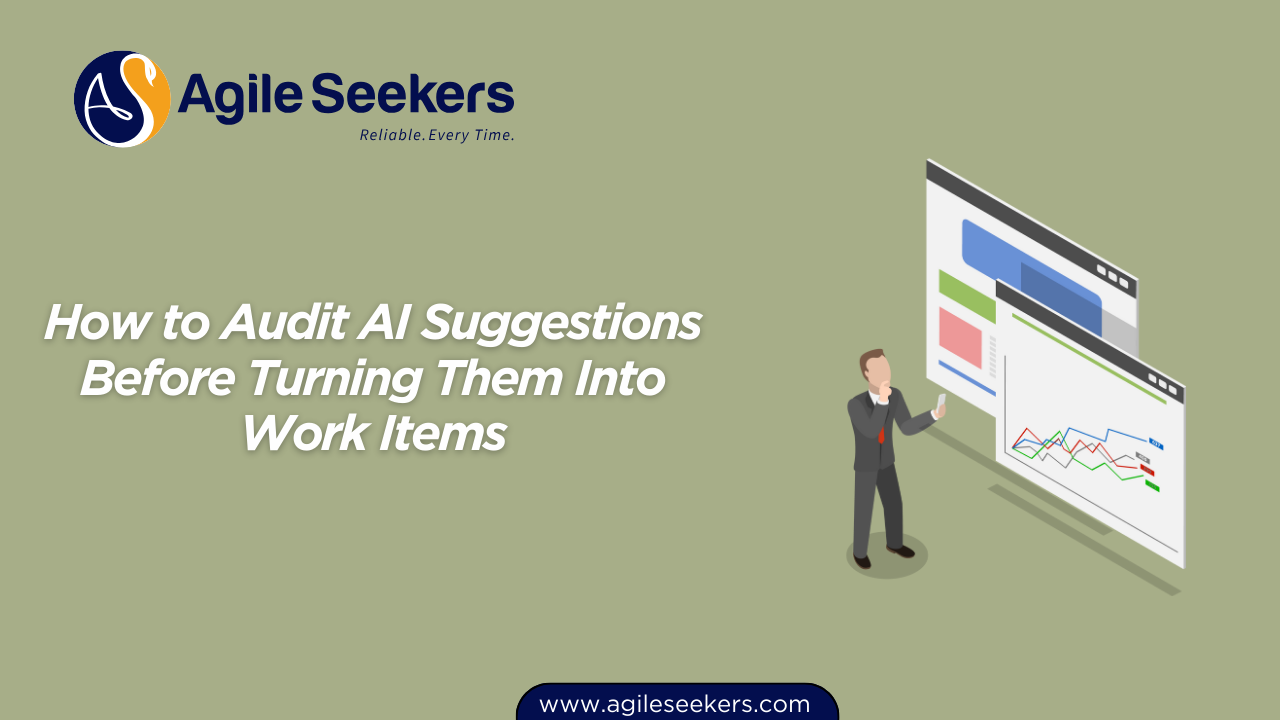
AI tools can draft user stories, suggest PI objectives, identify risks, summarize research, and even recommend backlog priorities. The speed feels impressive. But speed without scrutiny creates noise, misalignment, and hidden risk.
If you directly convert AI suggestions into work items, you hand over product judgment to a system that does not understand your context, constraints, politics, or customers the way your teams do.
This guide explains how to audit AI suggestions before turning them into backlog items, features, or PI commitments. It focuses on practical steps you can apply inside Scrum teams, Agile Release Trains, and large enterprise environments using SAFe.
Why Auditing AI Suggestions Matters in Agile Delivery
AI models generate patterns based on past data. They do not understand your value stream strategy, regulatory boundaries, architectural runway, or funding guardrails. If you treat AI output as ready-to-build requirements, you risk:
- Building technically elegant but strategically irrelevant features
- Committing to vague or non-testable stories
- Introducing hidden compliance or security risks
- Creating scope creep across ARTs
- Overloading teams with low-value work
Leaders who complete Leading SAFe agilist certification quickly realize that alignment to strategy and Lean Portfolio priorities matters more than volume of ideas. AI can help generate ideas. It cannot decide which ideas deserve investment.
Auditing AI suggestions protects flow, budget, and credibility.
Step 1: Validate Strategic Alignment First
Before you analyze technical feasibility, ask one simple question: does this AI-generated suggestion align with current strategic themes or OKRs?
Every suggestion must connect to:
- Portfolio epics or strategic initiatives
- Value stream outcomes
- Customer-centric metrics
If the suggestion does not clearly support an objective, stop there. Do not refine it. Do not estimate it. Archive it.
Teams often use frameworks like Lean Portfolio Management to ensure investments stay aligned with strategy. Apply the same discipline to AI-generated ideas.
AI produces possibilities. Strategy decides priority.
Step 2: Check for Context Blind Spots
AI does not automatically know:
- Your current architectural constraints
- Legacy system dependencies
- Security policies
- Market timing realities
- Existing roadmap commitments
When auditing AI suggestions, explicitly ask:
- What assumptions is this suggestion making?
- Are those assumptions valid in our environment?
- Does it ignore technical debt or integration complexity?
Product Owners and Product Managers who complete SAFe Product Owner Product Manager Certification learn to continuously balance desirability, feasibility, and viability. Use that lens here.
An AI suggestion may sound brilliant. If it ignores reality, it is just a well-written fantasy.
Step 3: Translate AI Output Into Testable Hypotheses
AI suggestions often appear as feature descriptions or user stories. Do not copy and paste them directly into Jira or Azure DevOps.
Instead, convert each suggestion into a hypothesis:
If we implement this capability, we expect [measurable outcome] for [specific customer segment] within [time frame].
If you cannot clearly define:
- Who benefits
- What changes
- How you measure success
then the idea is not ready for the backlog.
For guidance on writing measurable objectives, refer to Atlassian’s explanation of OKRs. The principle applies to AI suggestions as well: clarity before commitment.
Step 4: Run a Risk and Compliance Scan
AI-generated work items can unintentionally introduce:
- Data privacy risks
- Bias in decision logic
- Regulatory violations
- Security exposure
Audit suggestions against:
- Information security standards
- GDPR or regional compliance laws
- Internal governance policies
Resources such as the NIST AI Risk Management Framework outline how to evaluate AI-related risks. Even if you are not building AI features, AI-generated suggestions can create risk.
Scrum Masters and Advanced Scrum Masters trained through SAFe Scrum Master Certification and SAFe Advanced Scrum Master Certification Training play a critical role here. They protect teams from hidden risk and help surface compliance concerns early.
Step 5: Detect Hidden Scope Creep
AI tends to expand ideas. A simple enhancement request can become a multi-system transformation proposal.
When auditing, ask:
- Is this suggestion expanding beyond the original problem?
- Does it introduce new domains or teams?
- Will it impact multiple ARTs?
If yes, escalate the idea to the right level. It may belong as:
- An enabler epic
- A portfolio epic
- A cross-ART dependency
Release Train Engineers who complete SAFe Release Train Engineer Certification Training understand how quickly scope can ripple across trains. AI output must respect system boundaries.
Step 6: Re-Estimate With Real Team Input
AI can suggest effort levels. Ignore them.
Only the delivery team can estimate complexity accurately because they know:
- Codebase condition
- Integration challenges
- Environment setup constraints
- Test automation gaps
Bring the AI-generated idea into backlog refinement. Let the team:
- Break it down
- Challenge it
- Identify unknowns
If refinement reveals ambiguity, send it back for clarification rather than forcing it into sprint planning.
Step 7: Evaluate Opportunity Cost
Every AI suggestion competes with existing backlog items. Auditing means asking:
- What will we delay if we build this?
- Does this create more value than our current top priority?
- Are we chasing novelty over impact?
Use WSJF (Weighted Shortest Job First) where appropriate. This Lean-Agile prioritization model helps compare cost of delay against job size.
If an AI-generated idea does not outperform current priorities, it waits.
Step 8: Stress-Test Acceptance Criteria
AI often produces generic acceptance criteria. Audit them for:
- Testability
- Edge cases
- Non-functional requirements
- Clear definition of done
Replace vague phrases like “should work smoothly” with measurable conditions.
For example:
- Response time under 2 seconds for 95% of requests
- Error rate below 0.5%
- Full audit log enabled
If acceptance criteria are weak, the work item is weak.
Step 9: Validate Data Sources and References
Sometimes AI suggestions include “industry data” or “customer insights.” Verify them.
Check:
- Are cited statistics real?
- Are sources credible?
- Are assumptions outdated?
Never embed unverified AI claims into business cases or PI objectives. Always validate against trusted research or internal analytics.
Step 10: Document Human Judgment
Auditing is not only about rejecting bad ideas. It is about documenting why you accept or reject suggestions.
Maintain transparency by recording:
- Why the idea aligns with strategy
- What risks were identified
- What trade-offs were made
This protects decision-making integrity and builds trust across stakeholders.
Common Mistakes Teams Make When Auditing AI Suggestions
1. Treating AI as an Authority
AI is a tool, not a product manager.
2. Skipping Risk Review
Teams rush promising ideas into sprints without security review.
3. Ignoring System Impact
Small features can create architectural instability.
4. Overloading Backlogs
AI increases idea volume. Without filtering, backlogs become cluttered and unfocused.
Building a Sustainable AI Auditing Workflow
Here is a practical workflow you can adopt:
- Generate AI suggestions.
- Run strategic alignment filter.
- Convert to hypothesis format.
- Conduct risk and compliance scan.
- Review cross-team impact.
- Refine with delivery team.
- Prioritize using WSJF or similar model.
- Approve for backlog only after passing all gates.
This structured audit protects both speed and quality.
Final Thoughts: Keep Humans in the Decision Loop
AI can accelerate idea generation. It can improve drafting. It can highlight patterns. But it cannot own accountability.
Product leadership, Scrum facilitation, architectural governance, and portfolio prioritization remain human responsibilities.
If you build a strong audit discipline, AI becomes a productivity multiplier instead of a risk multiplier.
Audit first. Then commit. That is how you turn AI suggestions into work items that actually create value.
Also read - Using AI to Draft Better PI Objectives Faster