Here’s the thing.
Most Scrum failures don’t happen because teams lack talent. They happen because risks stay invisible for too long.
A dependency slips. A story hides complexity. Velocity drops quietly for three sprints. A key developer burns out. Stakeholders change scope mid-PI.
By the time the problem becomes obvious, the damage is already done.
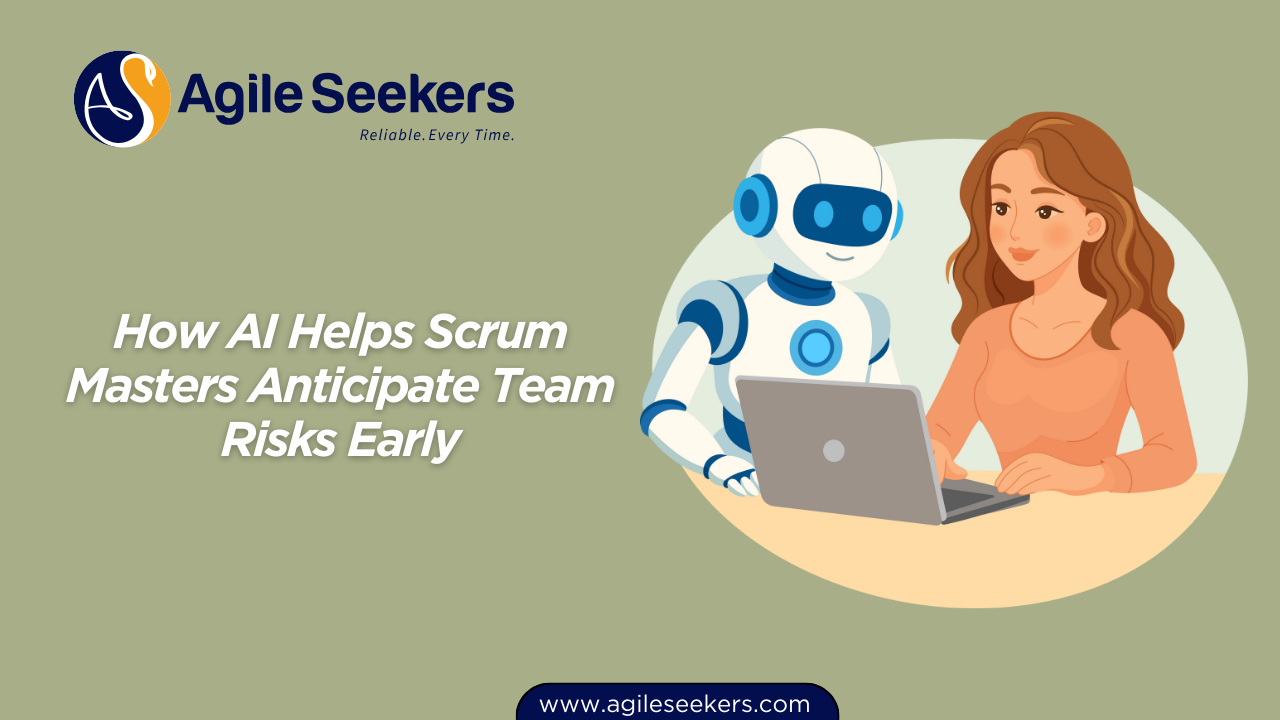
This is where AI changes the game for Scrum Masters.
Not by replacing judgment. Not by automating leadership. But by acting like an early warning system.
When used well, AI helps Scrum Masters spot patterns, signals, and weak links before they become blockers. It turns reactive firefighting into proactive risk management.
Let’s break down how this actually works in practice and how you can use it inside real Scrum and SAFe environments.
Why Early Risk Detection Matters More Than Speed
Many teams obsess over delivery speed. Story points. Burn-down charts. Sprint velocity.
Speed is nice. Predictability is better.
A predictable team can plan confidently, align with business goals, and deliver steady value. An unpredictable team creates chaos, escalations, and last-minute heroics.
Most unpredictability comes from risks that weren’t identified early:
- Hidden technical debt
- Unclear acceptance criteria
- Skill gaps
- Overloaded team members
- Cross-team dependencies
- Stakeholder churn
Scrum Masters traditionally detect these through observation and conversations. That still matters. But now you can add data-driven insights to strengthen those instincts.
This is where AI becomes a practical assistant.
What AI Actually Means for Scrum Masters
Let’s keep this simple.
AI here doesn’t mean robots or complicated math models. It means tools that analyze your existing delivery data and highlight risks automatically.
Examples:
- Sprint metrics analysis
- Historical velocity trends
- Sentiment analysis from retrospectives
- Dependency mapping
- Backlog quality scoring
- Predictive delivery forecasts
Think of AI as a second set of eyes that never gets tired.
You still lead. You still coach. AI just surfaces signals faster.
1. Predicting Delivery Slippage Before It Happens
Most teams only realize they’re late during the last few days of the sprint.
By then, it’s too late to adjust scope cleanly.
AI tools analyze historical sprint data and detect patterns such as:
- Velocity decline across 3–4 sprints
- Increasing spillover stories
- Growing story size variance
- Frequent carry-forwards
Based on these trends, they forecast likely completion dates.
If the system predicts a 40% risk of sprint failure by Day 4, you can act immediately:
- Re-scope work
- Split stories
- Swarm critical items
- Remove low-value scope
You move from guessing to informed decisions.
2. Spotting Weak Backlog Items Early
Poorly defined stories create the majority of sprint chaos.
Missing acceptance criteria. Vague descriptions. Oversized scope.
AI can review backlog items and flag risky ones by checking:
- Story length or ambiguity
- Lack of acceptance tests
- No estimation history
- Unusually large effort
Before sprint planning, the tool can say, “These five items carry higher delivery risk.”
Now you know exactly where to focus refinement time.
This makes planning tighter and reduces mid-sprint surprises.
3. Detecting Team Burnout Signals
Scrum Masters often sense burnout late.
People don’t always say they’re overloaded.
AI can combine signals like:
- After-hours commits
- Task overload per person
- Declining throughput
- Increased defect rates
- Sentiment from retrospective notes
When these stack up, you get a quiet alert.
That gives you space to intervene early:
- Rebalance work
- Introduce pairing
- Adjust sprint scope
- Coach sustainable pace
This protects both people and delivery outcomes.
4. Mapping Hidden Dependencies Across Teams
Dependencies are silent killers in scaled environments.
One blocked team can stall an entire ART.
AI can analyze Jira or Azure DevOps links and automatically generate dependency graphs. It highlights:
- Critical chains
- Cross-team bottlenecks
- Late upstream work
- High-risk integration points
Instead of discovering these during PI execution, you catch them during planning.
If you operate in a SAFe setup, this skill becomes essential. Many Scrum Masters strengthen this capability through formal training such as the SAFe Scrum Master Certification, where dependency management and ART coordination play a central role.
5. Improving Risk-Based Sprint Planning
Traditional sprint planning focuses on “what can we finish?”
AI helps you ask a better question:
“What might fail?”
By reviewing past delivery patterns, AI identifies:
- Story types that frequently spill over
- Complex domains that cause delays
- Teams with capacity constraints
With this information, you:
- Plan buffers intentionally
- Reduce risky scope
- Sequence work smarter
This leads to fewer last-minute escalations and calmer sprints.
6. Smarter Retrospectives with Data
Retrospectives often rely only on memory.
Memory is biased.
AI brings facts into the room:
- Cycle time trends
- Defect leakage
- Blocked hours
- Rework percentages
Now conversations shift from opinions to evidence.
Instead of “I feel we were slower,” you say, “Cycle time increased 18% because of external dependencies.”
That clarity leads to better action items.
7. Scaling Risk Management Across the ART
At the program level, risks multiply.
More teams. More integrations. More moving parts.
AI helps Release Train Engineers and Scrum Masters view risk across the entire train.
Forecasting tools, like the ones discussed in the Scaled Agile Framework guidance, show system-level flow metrics that reveal bottlenecks early.
If you want deeper expertise here, programs like the SAFe Release Train Engineer Certification Training build these system-thinking skills.
8. Strengthening Collaboration with Product Owners
Risk management doesn’t sit only with Scrum Masters.
Product Owners and Product Managers influence scope, priority, and value trade-offs.
AI helps both roles align faster.
For example:
- Forecasting WSJF inputs
- Validating assumptions with data
- Highlighting risky features
Many teams develop this partnership through the SAFe Product Owner Product Manager Certification, which connects product strategy with delivery realities.
9. From Scrum Master to Risk Coach
AI shifts your role slightly.
You stop being a meeting facilitator and become a risk coach.
You:
- Interpret signals
- Guide conversations
- Enable smarter decisions
- Protect team focus
The leadership side grows stronger.
That’s exactly what advanced programs like the SAFe Advanced Scrum Master Certification Training emphasize.
10. Practical Tools You Can Start Using Today
You don’t need expensive platforms to begin.
Start simple:
- Jira dashboards with predictive reports
- Monte Carlo forecasting plugins
- Retrospective sentiment tools
- Flow metrics from Kanban guidance
- ChatGPT-style assistants for backlog clarity checks
Layer sophistication gradually.
The goal is clarity, not complexity.
Common Mistakes to Avoid
- Blindly trusting predictions without human judgment
- Over-automating conversations
- Collecting too many metrics
- Using AI to micromanage people
Remember, AI supports leadership. It doesn’t replace empathy.
Building the Right Skills
Tools alone won’t help if you lack foundational Agile skills.
Risk anticipation requires:
- System thinking
- Facilitation
- Coaching mindset
- Data literacy
If you’re stepping into scaled delivery, structured learning like the SAFe agilist certification helps you connect team-level risks with enterprise strategy.
Final Thoughts
Here’s what this really means.
Great Scrum Masters don’t just react to problems. They prevent them.
AI gives you earlier visibility. You still bring the judgment, empathy, and leadership.
Together, that combination is powerful.
You catch risks sooner. Teams feel calmer. Delivery becomes predictable. Stakeholders trust the plan.
That’s not hype. It’s simply better awareness.
Start small. Add one dashboard. Track one signal. Run one experiment.
Then build from there.
Because the earlier you see a risk, the easier it is to solve.
Also read - Using AI to Detect Sprint Overcommitment Patterns
Also see - AI-Driven Retrospectives: Turning Signals Into Actions