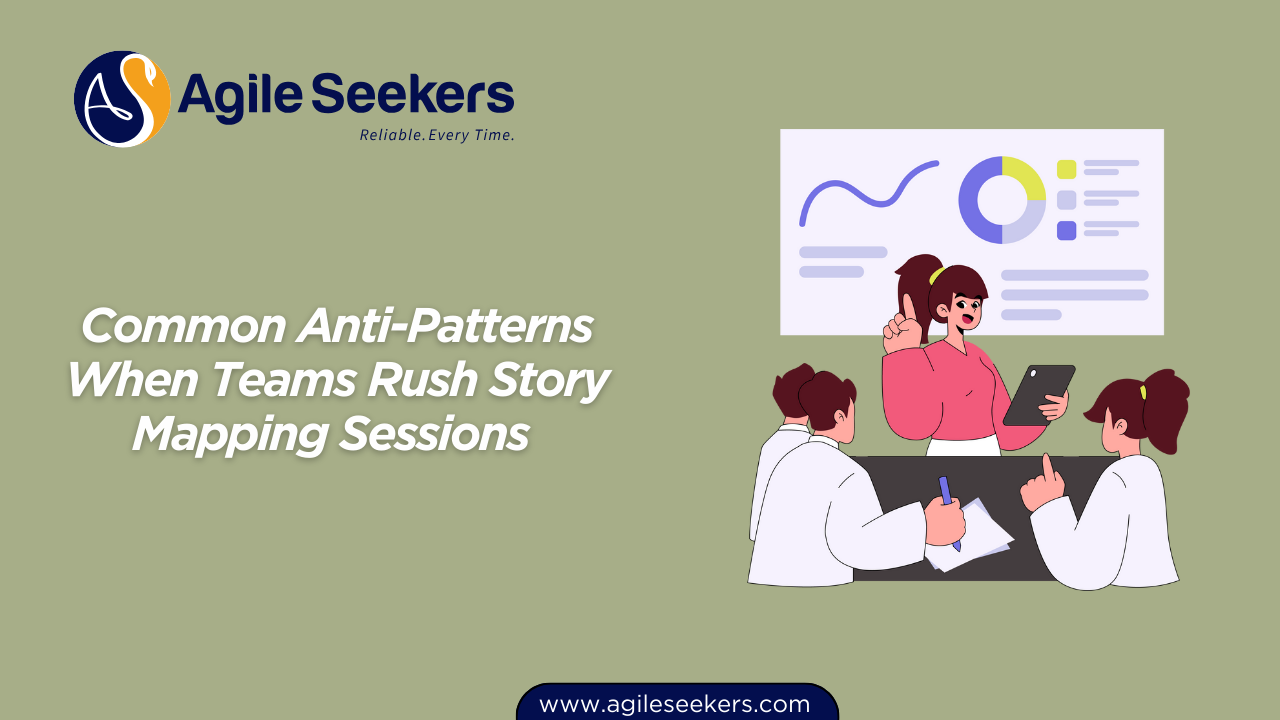
Story mapping looks simple from the outside, but it only works when the team slows down enough to think, debate, and refine ideas. When the session is rushed, the map becomes a colorful board that hides blind spots instead of revealing them. Teams walk away feeling productive, but the resulting map tells only half the story.
This detailed guide walks through the most common anti-patterns that show up when teams hurry through story mapping, why they happen, and how to avoid them. You’ll also see natural references to key Agile roles and practices that strengthen story mapping skills. Programs such as SAFe agilist certification help leaders understand how story mapping ties strategic intent to execution.
1. Starting With Features Instead of User Activities
Here’s the thing: story mapping isn’t a feature dump. Yet rushed teams almost always begin with features. Someone says “let’s add search,” someone else says “add login,” and the map quickly becomes a backlog disguised as a poster.
Why it happens: It feels faster to list solutions than to explore the user journey.
Why it’s a problem: You lose your north star. The map stops reflecting real user behavior and instead mirrors internal assumptions.
What to do instead: Anchor the entire conversation around user activities like exploring, comparing, deciding, completing, tracking, or revising. This mindset shift is reinforced through approaches taught in the SAFe POPM certification, which focuses on value-driven product thinking.
2. Treating It as a One-Pass Exercise
Some teams rush the process because they believe they must “finish the map today.” They treat story mapping like filling out a form.
Why it happens: People treat workshops like standard meetings instead of iterative working sessions.
Why it’s a problem: A single pass traps the team in their first assumptions, which are rarely accurate.
What to do instead: Move through several passes: outline → activities → steps → stories → slicing → validation. This layered approach mirrors the inspect-and-adapt rhythm emphasized in SAFe Scrum Master certification training.
3. Skipping Cross-Functional Participation
Rushed teams try to simplify the session by inviting fewer people. They promise to involve others later, but later often never comes.
Why it happens: Scheduling feels easier with fewer people.
Why it’s a problem: Missing perspectives, sales, architecture, customer support, UX, operations, create blind spots that lead to rework.
What to do instead: Bring cross-functional members for at least the first two layers of mapping. This aligns with the systems-thinking mindset reinforced in the SAFe Advanced Scrum Master certification training.
4. Prioritizing Before Understanding
Teams in a hurry often jump straight to the MVP slice before the map is even complete. They want quick answers.
Why it happens: Stakeholders push for “decisions now.”
Why it’s a problem: The team ends up prioritizing incomplete or poorly understood work.
What to do instead: Complete the backbone and walking skeleton before prioritizing. Structured flow and decision-making are core ideas in the SAFe Release Train Engineer certification training.
5. Over-Focusing on the Happy Path
Rushed sessions tend to produce clean, linear happy paths. Everything looks smooth. No friction. No obstacles.
Why it happens: Happy paths are easier and faster to map.
Why it’s a problem: Most real-world complexity hides in the unhappy paths: system errors, missing data, unusual user behavior, or skipped steps.
What to do instead: Ask powerful questions: “What could go wrong here?” “What if the user hesitates?” “What if the system fails?” Even quick probing helps uncover risks and hidden steps.
6. Missing the Real Customer Goal
Rushed teams often define goals that are technical or internal. They skip the deeper conversation about the user’s real intent.
Why it happens: It feels obvious, so teams assume they already know.
Why it’s a problem: When the goal is unclear, the story map becomes uneven. Some steps get inflated, others get overlooked.
What to do instead: Confirm the user’s core motive before drawing anything. This connects directly to the value alignment practices taught in SAFe Scrum Master certification.
7. Allowing One Strong Voice to Dominate
When time is short, debate feels inconvenient. One person speaks confidently, others nod, and the map becomes a single perspective instead of a shared model.
Why it happens: People don’t want to slow down the discussion.
Why it’s a problem: The map reflects biases instead of collective insight.
What to do instead: Assign a facilitator to balance participation, challenge assumptions, and guide the pace. Leadership collaboration techniques covered in Leading SAFe training help teams build this muscle.
8. Treating the Story Map as an Artifact Instead of a Tool
Some teams create the story map, admire it, take a photo, and then never revisit it.
Why it happens: Rushed teams see the map as a workshop output instead of a living guide.
Why it’s a problem: The map becomes outdated quickly. It stops driving planning or refinement.
What to do instead: Keep the map active in backlog refinement, PI planning, and UX discussions. This approach is reinforced in the SAFe POPM certification.
9. Mapping Steps at the Wrong Level of Detail
Rushed sessions swing between extremes: too high-level or too detailed.
Why it happens: People don’t pause to align on the right depth.
Why it’s a problem: Too high-level makes slicing useless. Too detailed turns the map into noise.
What to do instead: Aim for detail that supports flow understanding, not task estimation.
10. Skipping Validation With Real Users
Teams sometimes assume the map is correct and move forward without checking it against real user behavior.
Why it happens: Validation feels slow.
Why it’s a problem: Assumptions slip in unnoticed, leading to rework and delivery delays.
What to do instead: Show the map to users, test with a quick prototype, or compare with analytics. External resources such as NN Group’s usability research offer helpful guidance.
11. Ignoring System Constraints Until the End
Rushed sessions focus on the ideal flow first, postponing technical realities.
Why it happens: Teams want to stay “creative” during mapping.
Why it’s a problem: By the time constraints surface, the entire map assumes unrealistic system behavior.
What to do instead: Bring architecture and system knowledge into the room earlier. This aligns with the flow-oriented decision-making practiced by RTEs and reinforced in SAFe Release Train Engineer certification training.
12. Slicing Horizontally Instead of Vertically
Rushed teams slice by components: login first, checkout later, dashboard after that. That’s not an MVP, it’s a disguised waterfall.
Why it happens: Vertical slicing requires more thought and discussion.
Why it’s a problem: Horizontal slicing delays delivery of usable value.
What to do instead: Slice thin vertical paths that deliver real outcomes. Many of these techniques are reinforced in the SAFe Scrum Master certification and POPM training.
13. Misjudging the MVP Line
Teams under time pressure mark the MVP line too high or too low. Both cause problems.
Why it happens: The team hasn’t slowed down enough to debate what “minimum” and “viable” really mean.
Why it’s a problem: You ship either a bloated MVP or an unusable one.
What to do instead: Ask four clarifying questions about user intent, value, trust, and assumptions. This produces a realistic and meaningful MVP slice.
14. Treating the Story Map as Static
Some teams treat the map as a final document instead of a working model that evolves.
Why it happens: Outputs from workshops are mistakenly treated as fixed.
Why it’s a problem: New insights don’t get integrated, making the map obsolete.
What to do instead: Revisit and adjust the map regularly, during refinement, planning, or after new user learning.
Final Thoughts
When teams rush story mapping sessions, they lose the clarity and shared understanding that story mapping is meant to create. Most anti-patterns disappear when teams slow down, include the right voices, and treat the map as a strategic tool rather than a checkbox exercise.
Teams that want to build stronger habits in user-value thinking, slicing, and system-level collaboration often benefit from certifications such as:
- Leading SAFe agilist certification
- SAFe POPM certification
- SAFe Scrum Master certification
- SAFe Advanced Scrum Master certification training
- SAFe Release Train Engineer certification training
With stronger skills and a more deliberate approach, story mapping becomes one of your most reliable tools for shaping user-centered delivery.
Also read - What a Strong MVP Looks Like Through a Story Map