Sprint Planning looks logical on the surface. Teams review the backlog, estimate effort, commit to a goal, and move on. Yet even experienced Agile teams struggle to get it right. Missed commitments, overloaded sprints, last-minute scope changes, and frustrated stakeholders often trace back to something less visible than poor tooling or weak facilitation.
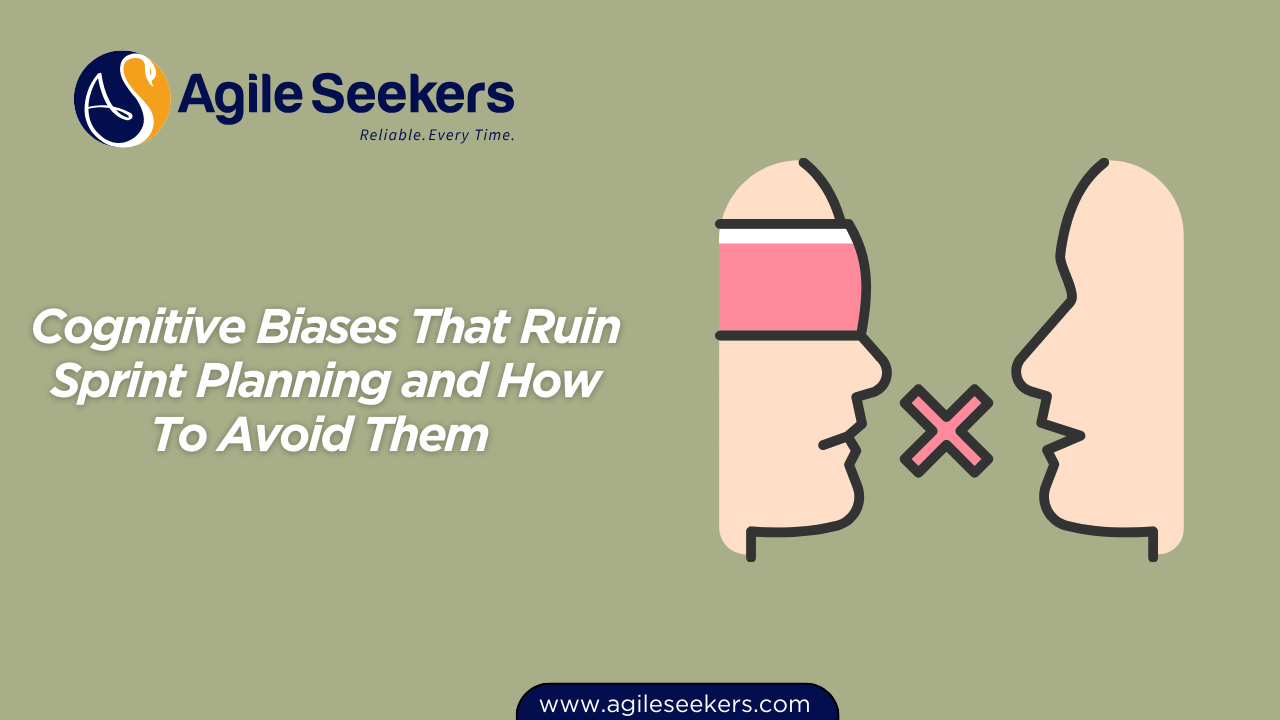
Here’s the thing. Sprint Planning is a human activity. Humans bring assumptions, shortcuts, habits, and blind spots into the room. These mental shortcuts are known as cognitive biases, and they quietly shape decisions long before anyone notices the damage.
This article breaks down the most common cognitive biases that derail Sprint Planning, how they show up in real teams, and what you can do to counter them without turning planning into a rigid ceremony. If you are a Product Owner, Scrum Master, Release Train Engineer, or Agile leader, understanding these biases will immediately improve the quality of your plans and the confidence behind your commitments.
Why Cognitive Biases Matter in Sprint Planning
Sprint Planning demands judgment. Teams estimate uncertainty, forecast capacity, assess risk, and align work with goals. None of this happens in a vacuum. Bias creeps in when teams rush decisions, lean too heavily on past experiences, or try to please stakeholders at the expense of reality.
When these biases go unchecked, teams commit to work they cannot finish, ignore technical risks, underestimate complexity, and confuse optimism with feasibility. Over time, this erodes trust in planning altogether.
Strong Sprint Planning is not about perfect estimates. It is about making conscious decisions with shared understanding. The first step is knowing what gets in the way.
Planning Fallacy: Overconfidence Disguised as Optimism
The planning fallacy pushes teams to believe work will take less time than it actually does, even when history proves otherwise. Teams remember best-case scenarios and quietly dismiss past delays as exceptions.
During Sprint Planning, this bias shows up when teams say things like “We’ve done something similar before” or “It shouldn’t take long.” The result is a sprint packed with work that assumes everything will go right.
How to avoid it:
- Start Sprint Planning by reviewing actual completion data from previous sprints.
- Ask what went wrong last time and factor that into estimates.
- Encourage teams to estimate based on evidence, not confidence.
Many teams learn structured forecasting and capacity planning techniques while attending SAFe Scrum Master Certification programs, where empirical planning replaces optimistic guessing.
Anchoring Bias: When the First Number Wins
Anchoring bias occurs when the first estimate mentioned becomes the reference point for all further discussion. Once someone throws out a number, the team unconsciously adjusts around it instead of starting fresh.
This often happens when senior developers, architects, or managers speak first. Even if the number is flawed, it sets the tone for the rest of the planning session.
How to avoid it:
- Use silent estimation techniques like Planning Poker or relative sizing.
- Ask team members to write estimates down before discussion.
- Rotate who speaks first to balance influence.
Release Train Engineers often encounter anchoring issues at scale, which is why facilitation skills taught in SAFe Release Train Engineer training focus heavily on neutralizing dominant voices.
Confirmation Bias: Seeing Only What Supports the Plan
Confirmation bias leads teams to seek information that supports an existing plan while ignoring signals that suggest risk or overload. During Sprint Planning, this bias hides behind selective listening.
Teams may downplay dependency risks, unresolved design questions, or unstable environments because acknowledging them would force a harder conversation.
How to avoid it:
- Explicitly ask, “What could prevent us from finishing this sprint?”
- Invite dissent and reward those who surface risks.
- Use pre-mortems to imagine failure before committing.
Agile leaders trained through SAFe agilist certification often learn how to create environments where uncomfortable truths surface early rather than late.
Optimism Bias: Believing This Sprint Will Be Different
Optimism bias convinces teams that future sprints will be smoother than past ones, even without changes in system constraints. Teams assume fewer interruptions, cleaner handoffs, and better focus simply because they want it to be true.
This bias shows up when teams ignore known meetings, production support, or cross-team dependencies during capacity planning.
How to avoid it:
- Account for non-delivery work explicitly during planning.
- Reduce capacity intentionally rather than hoping for perfect focus.
- Track planned versus actual capacity over time.
Advanced Scrum Masters trained through SAFe Advanced Scrum Master Certification learn to coach teams out of habitual optimism by grounding plans in flow metrics.
Availability Bias: Recent Events Overshadow Reality
Availability bias causes teams to overweight recent experiences. A smooth sprint may cause teams to assume stability, while a chaotic sprint may trigger excessive caution.
Both reactions distort planning decisions. Teams either overload themselves after a good sprint or undercommit after a bad one, instead of looking at longer trends.
How to avoid it:
- Review multiple sprints, not just the last one.
- Use rolling averages instead of single-sprint data.
- Focus on system behavior, not isolated outcomes.
External research on cognitive biases from sources like Verywell Mind explains why recent memories dominate decision-making more than long-term evidence.
Authority Bias: Deferring to the Loudest Voice
Authority bias leads teams to accept estimates or commitments from senior roles without challenge. Product Owners, managers, or architects may unintentionally pressure teams into unrealistic sprint goals.
This bias erodes psychological safety and turns Sprint Planning into a performance instead of a negotiation.
How to avoid it:
- Reinforce that Sprint Planning is a team decision, not a directive.
- Encourage data-backed discussion rather than positional authority.
- Let teams own capacity and commitment.
Product Owners trained through SAFe POPM Certification often learn how to balance business urgency with team sustainability.
Sunk Cost Fallacy: Continuing Work That No Longer Fits
Sunk cost fallacy pushes teams to keep pulling work into sprints simply because effort has already been invested. Teams hesitate to de-scope or re-prioritize partially completed stories.
This leads to bloated sprints filled with low-value work that blocks higher-impact outcomes.
How to avoid it:
- Re-evaluate backlog items based on current value, not past effort.
- Normalize removing or splitting stories during planning.
- Focus sprint goals on outcomes, not task completion.
Behavioral research published by The Decision Lab explains why teams struggle to let go of work they have already started.
Groupthink: Consensus Without Critical Thinking
Groupthink occurs when teams prioritize harmony over honesty. Everyone nods along, even when doubts exist, because disagreement feels uncomfortable.
The result is a sprint plan that looks aligned but collapses under pressure.
How to avoid it:
- Ask each team member for explicit buy-in.
- Invite alternative viewpoints before finalizing commitments.
- Break large groups into smaller discussions when needed.
How Strong Sprint Planning Changes When Bias Is Addressed
When teams actively counter cognitive biases, Sprint Planning shifts from hopeful forecasting to intentional commitment. Capacity becomes realistic. Risks surface early. Trade-offs become visible.
Teams stop treating missed commitments as failures and start seeing them as learning signals. Over time, trust improves between teams and stakeholders because plans reflect reality rather than wishful thinking.
More importantly, teams regain confidence in their own judgment.
Building Bias Awareness Into Your Planning Culture
You do not need complex frameworks to reduce bias. You need consistency, reflection, and psychological safety.
- Use retrospectives to identify which biases showed up.
- Rotate facilitation roles during planning.
- Ground every commitment in data, not pressure.
Sprint Planning works best when teams accept that bias will always exist. The goal is not elimination. The goal is awareness and correction.
Final Thoughts
Cognitive biases quietly sabotage Sprint Planning long before execution begins. They hide behind confidence, optimism, and experience. Once teams learn to spot them, planning becomes sharper, calmer, and more honest.
Better Sprint Planning is not about doing more work. It is about making clearer decisions together. When teams plan with awareness instead of assumption, delivery follows naturally.
Also read - Advanced Capacity-Planning Techniques for Sprint Planning
Also see - How to Plan Sprints When Product Discovery Is Still Ongoing
A practical sequence to apply this guidance
- Why Cognitive Biases Matter in Sprint Planning: Clarify the decision, people affected and evidence needed before acting.
- Planning Fallacy: Overconfidence Disguised as Optimism: Apply the guidance to one current example and record important constraints.
- Anchoring Bias: When the First Number Wins: Choose one small action with an owner, boundary and review date.
- Confirmation Bias: Seeing Only What Supports the Plan: Compare the result with the intended outcome and update the approach.
Use the sequence as a decision aid, not a rigid template. Preserve the article's context and adapt the steps when evidence, risk or authority differs.