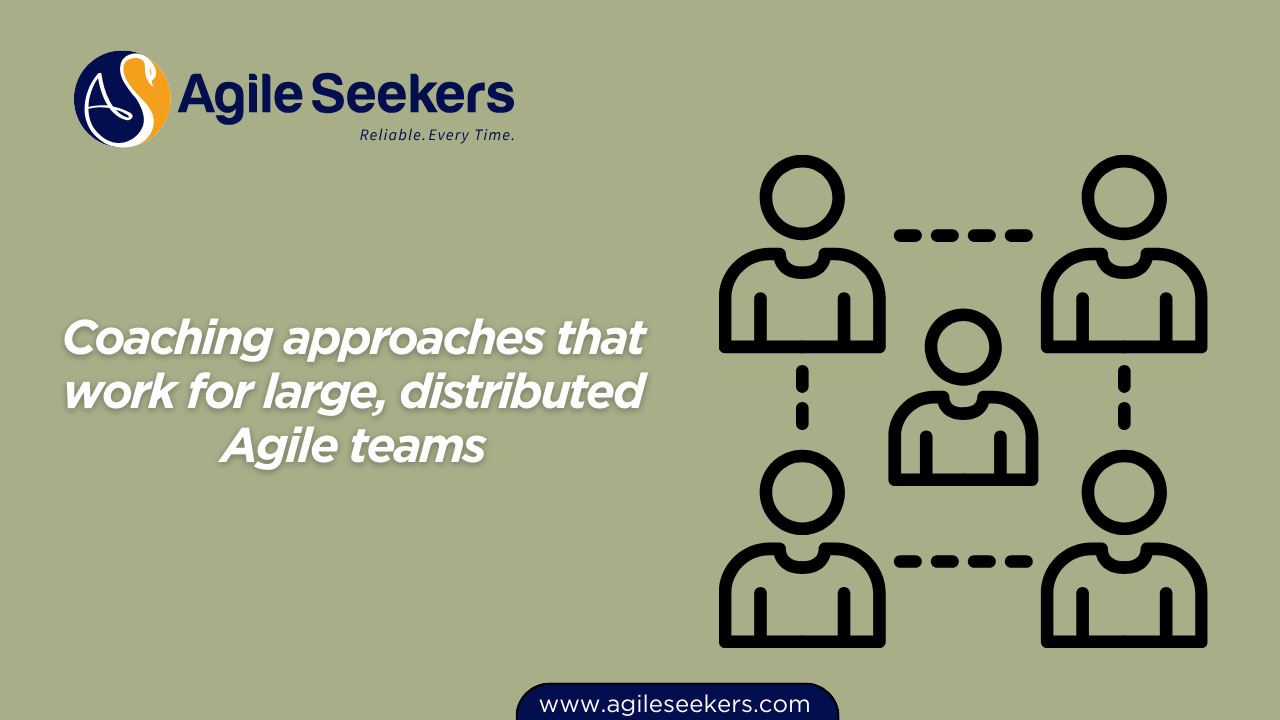
Here’s the thing about large, distributed Agile teams: most coaching advice breaks down the moment teams spread across time zones, cultures, and reporting lines. What works for a single colocated Scrum team rarely scales cleanly to dozens of teams working on shared outcomes.
Coaching in this context is not about running better ceremonies or fixing Jira workflows. It’s about shaping behaviors, decision-making, and alignment at scale. This article breaks down coaching approaches that actually work when teams are large, distributed, and operating inside complex systems.
Why Traditional Agile Coaching Falls Short at Scale
Many Agile coaches start with the same playbook they used for small teams: more stand-ups, tighter sprint reviews, better retrospectives. For distributed environments, that often creates more meetings, not better outcomes.
Large-scale Agile environments introduce real constraints:
- Teams operate across multiple time zones
- Dependencies span teams, systems, and vendors
- Decision authority sits outside the team
- Leaders want predictability, not just velocity
If coaching focuses only at the team level, these constraints remain untouched. Effective coaching shifts its center of gravity upward and outward.
Start with System-Level Coaching, Not Team-Level Fixes
For large, distributed teams, the system is the product. Coaches need to work on flow, decision latency, and alignment before worrying about team maturity.
This means coaching leaders, managers, and cross-team roles alongside delivery teams. Frameworks like SAFe explicitly recognize this need, which is why leadership enablement plays such a central role in Leading SAFe certification.
System-level coaching focuses on questions like:
- Where do decisions get stuck?
- Which dependencies slow delivery the most?
- How does work move from idea to release?
- Who owns outcomes across team boundaries?
Until these are addressed, team-level coaching delivers diminishing returns.
Coach Around Value Streams, Not Org Charts
Distributed teams often align to departments rather than value delivery. Coaching becomes effective when it reorients conversations around value streams.
Instead of asking how Team A can improve, ask how customer value flows across Team A, Team B, and Team C. This shift changes the nature of improvement conversations.
External research from the Scaled Agile Framework highlights how value stream alignment reduces handoffs and delays when working at scale. The official SAFe guidance on value streams explains this clearly and provides practical examples of organizing work around value rather than hierarchy.
Coaches should facilitate mapping sessions that cut across geography and reporting lines. These sessions surface hidden queues, approval delays, and conflicting priorities that teams alone cannot fix.
Move from Facilitation to Decision Coaching
In distributed environments, the real bottleneck is often decision-making, not execution. Teams wait for approvals, clarifications, or priority calls that never arrive on time.
Coaching must help leaders clarify:
- What decisions teams can make independently
- What decisions require escalation
- What principles guide trade-offs
This is where coaching intersects strongly with product and leadership roles. Product Owners and Product Managers, especially in scaled environments, benefit from clarity on decision boundaries. That’s why many coaches align closely with teams pursuing SAFe Product Owner Product Manager (POPM) certification.
Decision coaching replaces vague empowerment with explicit authority.
Establish Coaching Cadence Across Time Zones
Distributed teams rarely share overlapping hours. Coaching approaches must respect that reality instead of fighting it.
Effective coaches use a mix of synchronous and asynchronous techniques:
- Recorded coaching sessions for reuse
- Written coaching prompts in shared tools
- Asynchronous retrospectives with clear themes
- Rotating time-zone-friendly live sessions
The goal is consistency, not constant presence. Teams should know when and how coaching support is available, even if it’s not always live.
Coach Scrum Masters as Multipliers
In large Agile environments, one coach cannot scale impact alone. Scrum Masters become the primary use point.
Instead of coaching teams directly, experienced coaches focus on developing Scrum Masters as coaches themselves. This includes:
- Advanced facilitation skills
- Conflict navigation in distributed teams
- Coaching leaders, not just teams
- Using metrics as conversation starters
Programs aligned with SAFe Scrum Master certification build foundational capability, while deeper system coaching skills develop further through SAFe Advanced Scrum Master training.
When Scrum Masters grow as coaches, distributed teams gain local support without central bottlenecks.
Use Metrics as Mirrors, Not Targets
Large organizations love metrics. Distributed teams often fear them. Coaching bridges this gap by reframing metrics as learning tools.
Effective coaching uses system-level metrics such as:
- Flow time
- Predictability
- Dependency aging
- Release frequency
Instead of asking teams to hit numbers, coaches ask what the numbers reveal. This aligns with modern flow-based thinking promoted by industry research groups like the Flow Framework and DORA.
Metrics-driven conversations work especially well in distributed settings because data creates a shared reference point when teams rarely meet face to face.
Coach Leaders to Support Remote Trust
Distributed Agile teams fail quickly when trust erodes. Coaching must address leadership behaviors that unintentionally undermine trust.
Common anti-patterns include:
- Micromanaging through tools
- Using status meetings as control mechanisms
- Rewarding local optimization
Coaches help leaders replace control with clarity. This includes coaching around intent, outcomes, and feedback loops rather than activity tracking.
Leadership coaching is a core theme in scaled environments and strongly reinforced in roles like Release Train Engineers. That’s why many senior coaches align their practice with SAFe Release Train Engineer certification, where servant leadership and system optimization take center stage.
Normalize Cross-Team Retrospectives
Team-level retrospectives only surface part of the picture in distributed setups. Many problems live between teams.
Effective coaches facilitate cross-team retrospectives focused on:
- Dependency management
- Integration pain points
- Planning mismatches
- Communication breakdowns
These sessions work best when they are short, focused, and tied to specific outcomes. They also build empathy across locations and functions.
Anchor Coaching in Shared Principles
Distributed teams interpret Agile differently unless grounded in shared principles. Coaches reinforce these principles continuously.
Referencing foundational sources like the Agile Manifesto principles helps align conversations across geography and experience levels.
Principle-based coaching scales better than rule-based coaching. It allows teams to adapt practices without losing alignment.
Shift from Teaching to Sensemaking
Large organizations already know Agile terminology. What they lack is shared understanding.
Effective coaches focus less on teaching frameworks and more on helping teams and leaders make sense of their reality. This includes:
- Connecting strategy to team-level work
- Clarifying why certain changes matter
- Surfacing assumptions behind decisions
Sensemaking conversations create alignment that tools and processes alone cannot.
What This Really Means for Agile Coaches
Coaching large, distributed Agile teams requires a shift in identity. Coaches move from team facilitators to system stewards.
The most effective coaches:
- Work across roles and levels
- Focus on flow and decision-making
- Develop internal coaching capability
- Balance empathy with accountability
They also invest in their own growth through structured learning paths that reflect the realities of scale.
Closing Thoughts
Large, distributed Agile teams are not a problem to be fixed. They are complex systems to be understood.
Coaching approaches that work at this scale embrace complexity, elevate leadership, and build alignment through shared understanding. When done well, coaching becomes the connective tissue that turns distributed teams into a coherent delivery system.
That is where real agility starts.
Also read - How SAFe works for non-software teams, HR, legal, ops examples
Also see - Creating a culture of continuous improvement across ARTs