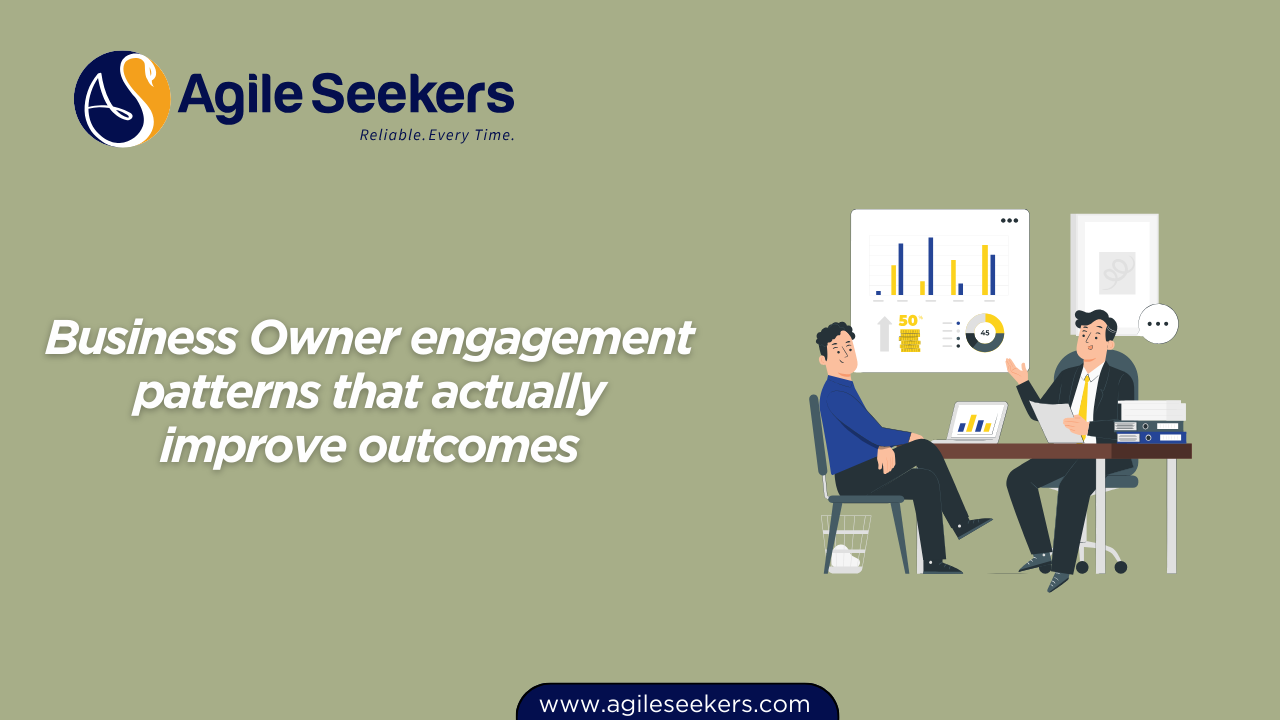
Most Agile transformations struggle for one simple reason: Business Owners stay involved just enough to approve funding and attend big ceremonies, but not enough to shape real outcomes. When that happens, teams deliver outputs, not impact. Roadmaps look busy. Value stays fuzzy.
Here’s the thing. Business Owner engagement is not about showing up more. It’s about showing up differently. The patterns that work are intentional, repeatable, and grounded in how value really flows through the organization.
This article breaks down the engagement patterns that consistently improve outcomes across Agile and SAFe environments. These are not theoretical ideals. They come from what actually works when Business Owners stop acting like sponsors and start acting like value stewards.
Why Business Owner Engagement Fails So Often
Before jumping into what works, it helps to be honest about what usually goes wrong.
- Business Owners delegate decision-making but keep escalation power
- They attend PI Planning but disengage during execution
- They focus on scope completion instead of outcome realization
- They treat metrics as reporting artifacts, not decision tools
The result is predictable. Teams wait for approvals. Product decisions slow down. Dependencies pile up. And when outcomes fall short, everyone blames execution instead of engagement.
Strong Business Owner engagement fixes this, but only when it follows clear patterns.
Pattern 1: Outcome Framing Before Work Starts
High-performing Business Owners never start with features. They start with outcomes.
Before a PI or major initiative begins, they answer three questions clearly and publicly:
- What business problem are we solving?
- What measurable change do we expect to see?
- How will we know this work was worth the investment?
This framing shapes everything that follows. Teams stop guessing what success looks like. Product Owners stop translating vague goals into overloaded backlogs.
In SAFe environments, this pattern shows up through strong PI Objectives with real business context and weighted value. Leaders who develop this skill deeply often emerge through programs like Leading SAFe certification, where outcome-based thinking replaces project-style planning.
What this really means is simple. If Business Owners cannot articulate outcomes, no amount of Agile execution will save the initiative.
Pattern 2: Consistent Participation in Economic Trade-Offs
Every Agile system runs into trade-offs. Speed versus quality. Local optimization versus system flow. Short-term gains versus long-term capability.
Engaged Business Owners do not avoid these conversations. They lead them.
Instead of pushing teams to “do everything,” they actively participate in prioritization decisions using economic reasoning. They ask:
- What happens if we delay this?
- What risk are we accepting by moving faster?
- What opportunity cost are we ignoring?
This pattern is especially visible during backlog refinement and PI Planning. When Business Owners engage alongside Product Owners and Product Managers, prioritization stops being political and starts becoming rational.
Roles trained through SAFe Product Owner Product Manager certification often act as bridges here, but Business Owners must still own the final economic decisions.
When they don’t, teams optimize for delivery speed instead of value.
Pattern 3: Decision-Making at the Right Altitude
One of the fastest ways Business Owners damage outcomes is by operating at the wrong level of detail.
Effective engagement follows a clear rule:
Business Owners decide “why” and “what,” not “how.”
They stay out of technical debates and solution design. At the same time, they stay deeply involved in:
- Defining success criteria
- Resolving cross-team conflicts
- Removing organizational constraints
This balance creates space for teams to move fast without losing alignment. Scrum Masters play a critical role in reinforcing this pattern, especially those trained through SAFe Scrum Master certification, where facilitation and boundary-setting become core leadership skills.
When Business Owners respect decision boundaries, trust increases and execution accelerates.
Pattern 4: Regular Presence During Execution, Not Just Planning
Many Business Owners show up strong at PI Planning and disappear until the next one. That gap creates drift.
Engaged Business Owners stay visible during execution in lightweight, intentional ways:
- Attending System Demos with real feedback
- Reviewing progress against outcomes, not tasks
- Making quick decisions when priorities shift
This does not mean daily involvement. It means predictable touchpoints where direction can adjust before problems compound.
Advanced Scrum Masters and flow-focused leaders often enable this cadence, especially those with SAFe Advanced Scrum Master training, who understand system-level impediments and escalation paths.
The signal this sends to teams is powerful. The work matters. Outcomes matter. And leadership is paying attention.
Pattern 5: Clear Ownership of Value, Not Just Funding
Funding work does not equal owning value.
Strong Business Owners take explicit responsibility for:
- Defining what value means for each initiative
- Tracking whether value is actually realized
- Stopping or pivoting work that no longer delivers
This pattern shifts conversations away from “are we done” toward “did this change anything.”
In mature SAFe organizations, Release Train Engineers help operationalize this transparency by connecting flow metrics, outcomes, and delivery signals. Leaders trained through SAFe Release Train Engineer certification often partner closely with Business Owners to keep value visible across the ART.
When Business Owners avoid this responsibility, teams keep shipping features long after the value has plateaued.
Pattern 6: Active Use of Metrics as Conversation Starters
Metrics do not improve outcomes. Conversations do.
Effective Business Owners treat metrics as signals, not scorecards. They regularly review:
- Flow metrics such as lead time and predictability
- Outcome indicators tied to customer or business impact
- Risk trends that suggest future constraints
Instead of asking, “Why is this number bad?” they ask, “What is this telling us?”
This approach creates psychological safety. Teams stop hiding problems. Leaders stop reacting too late.
For reference, Scaled Agile provides useful guidance on measuring flow and outcomes at the system level, which many organizations adapt from official SAFe resources available on Scaled Agile Framework.
Pattern 7: Fast Feedback Loops With Real Authority
Feedback without authority is noise.
Engaged Business Owners close the loop by ensuring that feedback leads to decisions. When they attend reviews or demos, they:
- Confirm whether outcomes are still valid
- Adjust priorities based on learning
- Authorize changes without lengthy escalation
This pattern keeps learning cycles short and prevents teams from building the wrong thing really well.
It also reinforces accountability. Feedback becomes practical because the right people are in the room.
Pattern 8: Visible Support for System-Level Improvements
Some of the most important work never shows up on a feature roadmap.
Reducing dependencies, improving flow, modernizing platforms, or investing in quality often competes with short-term delivery pressure.
Business Owners who improve outcomes consistently do one thing well. They publicly support system-level improvements and protect them from being deprioritized.
This support shows up in:
- PI Objectives that include enablement work
- Balanced investment across features, enablers, and maintenance
- Clear messaging that speed without sustainability is failure
When Business Owners stay silent here, teams burn out and systems decay.
What Changes When These Patterns Take Hold
Organizations that adopt these engagement patterns see consistent shifts:
- Faster decision-making with fewer escalations
- Clearer alignment between strategy and execution
- Higher trust between business and technology
- Measurable improvement in outcomes, not just output
Most importantly, Agile stops feeling like a process teams follow and starts functioning like a system leaders actively steer.
Final Thoughts
Business Owner engagement is not about control. It is about clarity, presence, and accountability.
The patterns that improve outcomes do not require heroic effort. They require consistency and the willingness to engage where it matters most.
When Business Owners frame outcomes, participate in trade-offs, stay visible during execution, and own value realization, Agile systems respond. Teams move with confidence. Leaders make fewer guesses. Results become predictable.
That is what real engagement looks like. And that is what actually improves outcomes.
Also read - Skills gap in scaled agile roles and how to close it
Also see - Visualizing flow at the enterprise level: metrics you should track