Put AI inside the loop, not in charge of it
AI can cluster interview notes, surface themes, draft hypotheses, create prototype variations, and help teams explore scenarios. It cannot own the product outcome, consent boundary, or decision to invest. A useful discovery loop assigns AI narrow transformation tasks while people retain responsibility for source quality, interpretation, risk, and the final product choice.
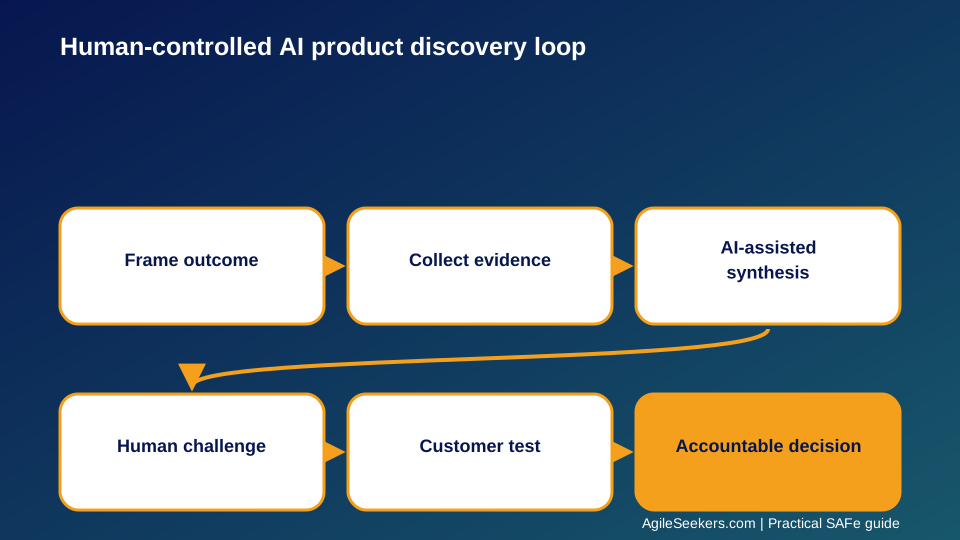
The six-stage discovery loop
- Frame the outcome, customer, constraints, and decision that discovery must inform.
- Collect consented qualitative and quantitative evidence with traceable sources.
- Use AI to organize, compare, summarize, or generate alternatives.
- Challenge outputs against raw evidence, edge cases, and excluded groups.
- Test the riskiest assumption with customers or a production-safe experiment.
- Decide to continue, pivot, pause, or stop; then record why.
The loop should shorten the distance between a claim and customer evidence. It should not merely increase the number of documents, ideas, or synthetic personas produced.
Choose tasks by error cost
| AI-assisted task | Potential value | Required control |
|---|---|---|
| Theme clustering | Faster navigation of large research sets | Reviewer checks clusters against source excerpts |
| Interview summary | Less manual transcription work | Preserve recording context and participant meaning |
| Hypothesis drafting | More alternatives considered | Product trio selects and rewrites testable claims |
| Prototype copy | Rapid variation | Brand, accessibility, legal, and user review |
| Scenario analysis | Expose possible outcomes | Validate assumptions and do not treat probability as fact |
Traceability is part of discovery quality
Store the source set, prompt or method, model and date where practical, generated output, human edits, and decision affected. This need not become heavy governance for every wording suggestion. The record should be proportional to impact. A high-stakes eligibility feature needs stronger traceability than an internal workshop agenda.
Bias checks before customer testing
- Whose data is overrepresented, missing, or outdated?
- Did summarization erase minority or contradictory views?
- Are synthetic outputs being mistaken for real customer evidence?
- Could sensitive attributes be inferred or exposed?
- Can a researcher reproduce the path from source to claim?
AI often produces a coherent average. Product discovery needs meaningful variation, inconvenient exceptions, and unmet needs. Reviewers should deliberately search the source material for evidence that does not fit the generated theme.
Connect learning to the ART backlog
Discovery finishes when learning changes an artifact or decision. A supported hypothesis may become a feature with benefit hypothesis and acceptance criteria. A technical uncertainty may create an enabler. A rejected assumption may remove work. Product Management should bring the outcome and evidence into backlog refinement without copying an AI-generated specification directly into delivery.
A two-week controlled experiment
Select one low-risk research set. Compare the existing human workflow with an AI-assisted workflow on time, missed themes, invented claims, reviewer effort, and usefulness to the decision. Predefine the acceptable error boundary. If time falls but verification cost or missed nuance rises, narrow the use case rather than declaring blanket success.
The SAFe POPM course provides the product-role context for discovery and feature decisions. Leading SAFe training is relevant when AI controls, data policy, and investment choices span the enterprise.
The accountable question
At the end of each loop, one named human decision owner should be able to explain the claim, supporting and contrary evidence, customer risk, and next choice without saying that the model decided. That is the simplest test of responsible AI-enabled discovery.
Also define a fallback for model or vendor change. Preserve original research in usable formats, keep a human-capable discovery method, and avoid making an opaque generated classification the only path to customer insight. Operational resilience applies to product learning as much as delivery.