Risk has always been part of Agile delivery. Teams identify risks during planning, track them on boards, and revisit them in retrospectives. That works well at a team level. But once you scale across multiple Agile Release Trains, portfolios, and business units, risk stops being visible. It becomes fragmented, delayed, and sometimes invisible until it turns into a real problem.
This is where AI-driven risk heatmaps change the game. They don’t replace Agile practices. They strengthen them by making risk visible, measurable, and predictable across the enterprise.
Let’s break this down in a practical way.
What Is a Risk Heatmap in Enterprise Agile?
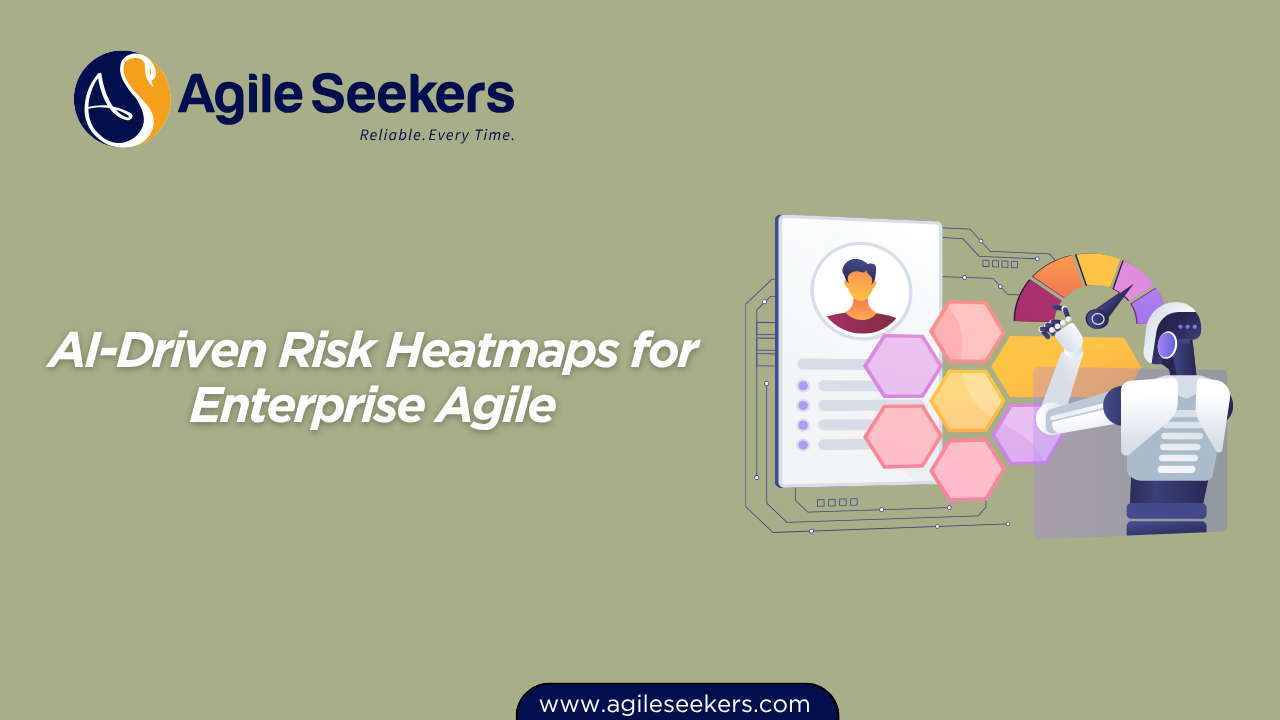
A risk heatmap is a visual representation of risk across different dimensions such as probability, impact, and urgency. Traditionally, teams create simple 2x2 or 3x3 grids where risks are categorized as low, medium, or high.
That works when you’re managing a single team or project. It falls apart when:
- Multiple teams report risks differently
- Dependencies create hidden risks
- Data becomes outdated quickly
- Leadership lacks real-time visibility
Enterprise Agile needs something more dynamic. That’s where AI steps in.
Why Traditional Risk Tracking Falls Short
Here’s the thing. Most Agile teams track risks manually. They rely on human judgment, which is valuable but limited.
Common problems include:
- Subjective scoring: One team’s “high risk” is another team’s “medium risk”
- Delayed updates: Risks are reviewed during ceremonies, not continuously
- Hidden dependencies: Risks spread across teams but stay unnoticed
- Lack of prioritization: Teams don’t always know which risks matter most
When you scale Agile using frameworks like SAFe, these gaps become more visible. Teams operate faster, but risk visibility often slows down.
That’s why organizations are now exploring AI-driven approaches.
What Makes AI-Driven Risk Heatmaps Different?
AI-driven risk heatmaps don’t just visualize risk. They analyze patterns, detect signals, and predict potential issues before they escalate.
Instead of relying only on manual input, AI pulls data from:
- Backlogs and user stories
- Sprint velocity trends
- Defect rates
- Dependency maps
- Release timelines
- Team communication signals
It then converts that data into a live, evolving risk map.
You don’t just see where risks are. You see where they are heading.
How AI Builds a Risk Heatmap
Let’s walk through how this works in practice.
1. Data Collection Across the Value Stream
AI connects to multiple systems such as Jira, Azure DevOps, and collaboration tools. It collects structured and unstructured data.
This includes delivery patterns, delays, blockers, and even sentiment signals from team discussions.
For a deeper understanding of flow and value streams, you can refer to insights shared on Scaled Agile Framework’s value stream guidance.
2. Pattern Detection
AI identifies patterns that humans often miss. For example:
- Repeated spillovers in a specific team
- Increasing defect rates in certain components
- Frequent dependency delays between two ARTs
These patterns indicate emerging risks.
3. Risk Scoring and Classification
Instead of static scoring, AI calculates dynamic risk scores based on probability and impact.
It adjusts scores in real time as new data flows in.
4. Visualization Through Heatmaps
The system generates heatmaps that highlight:
- High-risk areas in red
- Moderate risks in orange
- Low-risk zones in green
These heatmaps can be viewed at team, program, and portfolio levels.
5. Predictive Insights
This is where AI stands out. It doesn’t just show current risks. It predicts future ones.
For example:
- “This feature has a 70% chance of delay due to dependency risks”
- “This ART is trending toward capacity overload in the next PI”
That level of insight helps leaders act early.
Where AI-Driven Risk Heatmaps Fit in SAFe
In SAFe environments, risk management plays a critical role during PI Planning, execution, and Inspect & Adapt.
AI-driven heatmaps strengthen these moments.
During PI Planning
Teams identify risks using ROAM (Resolved, Owned, Accepted, Mitigated). AI enhances this by:
- Highlighting hidden risks based on past data
- Suggesting risk mitigation strategies
- Providing a data-backed view of dependencies
Professionals who go through a Leading SAFe agilist certification learn how to align strategy with execution, and AI-based risk insights make that alignment sharper.
During Iteration Execution
Risks evolve quickly during sprints. AI keeps tracking changes in real time and updates the heatmap.
Scrum Masters and teams can react faster instead of waiting for retrospectives.
That’s one of the practical advantages you explore in SAFe Scrum Master training, where flow and impediment removal become daily responsibilities.
At the Program Level
Release Train Engineers need a complete view of risks across teams.
AI-driven heatmaps provide:
- Cross-team risk visibility
- Dependency risk tracking
- System-level bottleneck identification
This aligns closely with the responsibilities covered in SAFe Release Train Engineer certification.
At the Portfolio Level
Leaders need to understand how risks impact strategic initiatives.
AI aggregates risks across value streams and connects them to business outcomes.
Product Owners and Managers benefit from this perspective, especially when working with large backlogs. This is a key focus area in SAFe POPM certification.
Real Benefits of AI-Driven Risk Heatmaps
Let’s move beyond theory and talk about actual impact.
1. Early Risk Detection
AI spots issues before they become visible in traditional tracking.
That gives teams more time to respond.
2. Better Decision Making
Leaders don’t rely on gut feeling alone. They use data-backed insights.
3. Improved Flow
By identifying bottlenecks and risks early, teams maintain smoother delivery.
4. Cross-Team Alignment
Risk visibility improves collaboration across teams and ARTs.
5. Continuous Learning
AI learns from past data and improves its predictions over time.
For a broader view on how AI is shaping Agile practices, you can explore this research on AI adoption trends.
Common Use Cases in Enterprise Agile
Organizations are already applying AI-driven risk heatmaps in several ways.
Release Planning
Teams use AI insights to identify risky features and adjust priorities.
Dependency Management
Heatmaps highlight risky dependencies across teams and systems.
Capacity Planning
AI predicts overload scenarios based on historical data.
Quality Risk Monitoring
Defect trends and test failures contribute to risk scoring.
Compliance and Governance
AI flags risks related to regulatory requirements or security concerns.
Advanced practitioners who want to deepen their understanding of scaling Agile practices can explore SAFe Advanced Scrum Master training, which connects team-level execution with system-level challenges.
Challenges You Should Expect
AI-driven risk heatmaps are powerful, but they are not magic.
There are practical challenges to consider.
Data Quality
AI depends on clean and consistent data. Poor data leads to misleading insights.
Over-Reliance on AI
AI should support decisions, not replace human judgment.
Integration Complexity
Connecting multiple tools and systems can take effort.
Change Management
Teams need to trust and adopt AI-driven insights.
Without proper adoption, even the best tools fail.
Proven methods to Get Started
If you’re planning to implement AI-driven risk heatmaps, start small and scale gradually.
1. Begin with One ART
Test the approach within a single Agile Release Train before scaling.
2. Focus on Key Metrics
Track a few meaningful indicators such as cycle time, defect rate, and dependency delays.
3. Combine AI with Human Insight
Use AI recommendations as inputs, not final decisions.
4. Train Teams
Help teams understand how AI generates insights and how to act on them.
5. Continuously Improve
Refine models and inputs based on feedback and outcomes.
The Future of Risk Management in Agile
Risk management is moving from reactive tracking to proactive prediction.
AI-driven heatmaps are part of a larger shift toward intelligent Agile systems.
We are moving toward environments where:
- Risks are detected automatically
- Decisions are supported by real-time data
- Teams focus more on delivery and less on manual tracking
This doesn’t replace Agile principles. It strengthens them.
Transparency improves. Feedback loops become faster. Decisions become clearer.
Final Thoughts
Enterprise Agile introduces scale, speed, and complexity. Managing risk at that level requires more than spreadsheets and manual tracking.
AI-driven risk heatmaps give organizations a way to see risk clearly, act early, and improve continuously.
The real advantage isn’t just visibility. It’s foresight.
Teams that learn how to combine Agile practices with AI-driven insights will move faster, adapt better, and deliver with more confidence.
That’s where Agile is heading next.
Also read - Using AI to Model Scenario-Based Roadmap Outcomes
Also see - Training Agile Leaders to Work Alongside AI Systems