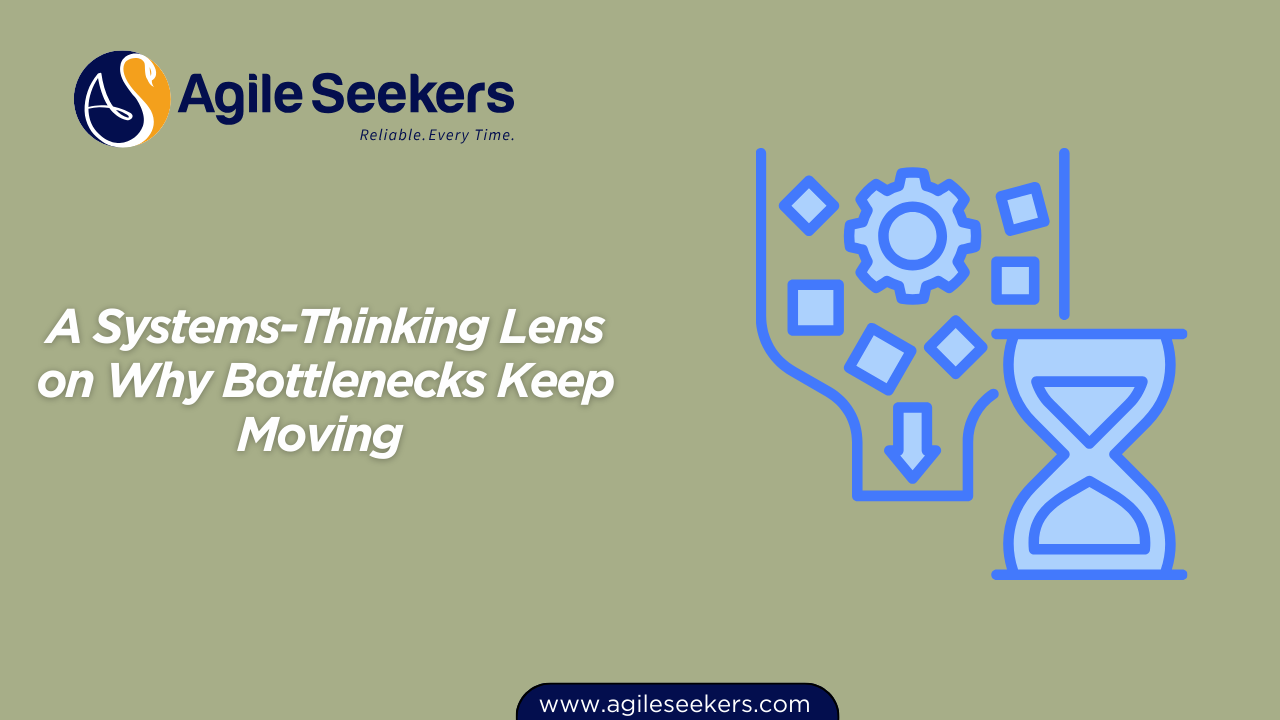
Teams fix one bottleneck, celebrate briefly, and then feel stuck again somewhere else. The constraint moves. Leaders get frustrated. Teams start questioning whether flow improvement even works.
Here’s the thing. Bottlenecks are not broken parts waiting to be repaired. They are signals from the system. When you look at delivery through a systems-thinking lens, shifting bottlenecks stop being a mystery and start making sense.
This article breaks down why bottlenecks keep moving, what systems thinking reveals about flow, and how Agile and SAFe practitioners can respond without chasing symptoms.
Why Bottlenecks Feel Like a Never-Ending Problem
Most organizations treat bottlenecks as local issues. A slow test phase. A busy architect. A single overworked Product Owner. Fix the visible problem and move on.
That approach assumes work behaves like a straight line. It doesn’t.
Product development behaves like a living system. Work interacts with policies, incentives, dependencies, decision latency, and human behavior. When you relieve pressure in one area, the pressure redistributes elsewhere.
From a systems perspective, this is expected behavior. The system is self-balancing. Improve one constraint and the next weakest point becomes visible.
What Systems Thinking Changes in How You See Flow
Systems thinking shifts the question from “Where is the bottleneck?” to “Why does the system create this bottleneck now?”
A system has four traits that matter here:
- Interconnected parts that influence each other
- Feedback loops that amplify or dampen behavior
- Delays between cause and effect
- Local optimizations that often hurt global flow
When teams ignore these traits, they keep fixing symptoms instead of structure.
Bottlenecks Move Because Flow Is Uneven by Design
No knowledge work system has uniform demand or capacity. Product discovery spikes. Production support interrupts planned work. Compliance reviews arrive late. Teams vary in skill mix.
Unevenness is normal.
When one stage improves, work accelerates until it hits the next constraint. That constraint may have existed all along, but it was hidden.
This aligns directly with Theory of Constraints. Every system has at least one constraint. Remove it and another appears.
The mistake is treating each new bottleneck as failure instead of feedback.
Local Optimization Is the Silent Bottleneck Creator
One of the fastest ways to create moving bottlenecks is optimizing teams in isolation.
Examples show up everywhere:
- Development increases throughput while testing capacity stays fixed
- Product Owners refine more stories without improving decision turnaround
- Teams reduce cycle time but increase work-in-progress upstream
Each improvement makes sense locally. Systemically, it shifts pressure.
Systems thinking pushes leaders to optimize for flow across the value stream, not utilization inside silos.
This is why SAFe agile certification emphasizes flow over efficiency and system health over team heroics.
Feedback Loops Accelerate or Slow Bottlenecks
Fast feedback exposes constraints quickly. Slow feedback hides them.
When teams get delayed signals about quality, customer impact, or integration risk, work piles up in the wrong places. The bottleneck appears suddenly and feels unpredictable.
Shortening feedback loops stabilizes flow. It does not remove bottlenecks, but it makes them visible earlier when they are cheaper to address.
This is one reason why Product Owners trained through SAFe POPM certification focus heavily on slicing work thin, validating assumptions early, and reducing decision latency.
Decision Latency Is Often the Real Constraint
Many bottlenecks are not technical. They are decision bottlenecks.
Work waits for approvals, prioritization, architecture guidance, or trade-off decisions. Teams appear idle while the system appears busy.
Decision latency behaves like inventory. The longer decisions take, the more work queues up behind them.
From a systems lens, speeding up decisions often delivers more flow improvement than adding people or tools.
Scrum Masters trained through SAFe Scrum Master certification learn to surface these invisible queues and facilitate faster cross-role alignment.
WIP Limits Move Bottlenecks Into the Open
Limiting work in progress doesn’t eliminate constraints. It forces them into view.
Without WIP limits, bottlenecks hide behind multitasking, overtime, and partial completion. With limits, work stops moving and the system signals where attention is needed.
This is why teams new to flow often feel things are getting worse before they get better.
In reality, the bottleneck was always there. The system just stopped masking it.
Why Scaling Makes Bottlenecks Shift Faster
At scale, dependencies multiply. Teams depend on shared services, platforms, vendors, and governance processes.
When one ART improves flow, upstream or downstream systems feel the pressure.
Release Train Engineers play a critical role here. Their job is not to remove every bottleneck but to manage flow across the train and coordinate systemic improvements.
This is why SAFe Release Train Engineer certification emphasizes system-level flow metrics and cross-team collaboration rather than local velocity.
Flow Metrics Reveal Patterns, Not Culprits
Cycle time, throughput, flow efficiency, and WIP trends show where the system struggles.
They do not tell you who failed.
When leaders use flow metrics to assign blame, teams start gaming the system. Bottlenecks go underground.
When leaders use metrics to ask better questions, patterns emerge.
Resources like SAFe Flow Metrics guidance help organizations focus on system behavior instead of individual performance.
Why Senior Teams Keep Recreating the Same Constraints
Leadership policies shape flow more than tools or ceremonies.
Funding models that batch approvals, role definitions that centralize decisions, and performance incentives tied to utilization all create predictable bottlenecks.
Teams adapt rationally to these constraints. Work queues grow. Bottlenecks shift but never disappear.
Advanced Scrum Masters trained through SAFe Advanced Scrum Master certification learn to coach leaders on changing system constraints, not just team behavior.
The Goal Is Not to Eliminate Bottlenecks
Every system has a constraint. That will not change.
The real goal is to:
- Detect constraints early
- Manage them deliberately
- Prevent harmful side effects when they move
When bottlenecks move smoothly and predictably, flow improves without chaos.
How to Respond When the Bottleneck Moves
Instead of reacting, pause and observe.
Ask questions like:
- What policy or behavior is amplifying this constraint?
- What feedback loop is delayed or missing?
- What decision is work waiting for?
- What local optimization increased pressure elsewhere?
This mindset turns bottlenecks into learning moments.
What This Really Means for Agile Organizations
If bottlenecks keep moving, your system is alive. That’s not a failure.
The danger comes from chasing each bottleneck with isolated fixes. Systems thinking replaces whack-a-mole with intentional flow management.
Organizations that build this capability stop asking “Why are we stuck again?” and start asking “What is the system telling us now?”
That shift separates teams that struggle with flow from those that sustain it.
Also read - Reducing Flow Time Variability Across Teams and ARTs
Also see - How to Build a Continuous Flow Improvement Model for Large Teams